28 January 2011

REMINER: Third International Congress of the World Society of Mixed Jurisdiction Jurists

The Third International Congress of the World Society of Mixed Jurisdiction Jurists will be held 20-23 June 2011 at the Hebrew University of Jerusalem, Israel.


The theme is 'Methodology and Innovation in Mixed Legal Systems':

Mixed legal systems, both the classical ‘mixed jurisdictions’ combining common law and civilian law and more exotic hybrids, are increasingly important touchstones for comparative law. The Third Congress of the World Society of Mixed Jurisdiction Jurists focuses on legal methodology and innovation in mixed systems in the twenty-first century: Investigating past experiences, exploring present practices, and predicting future possibilities

For additional information, including the (very diverse) provisional programme, see the conference website.

I hope to see many of you there.

12 January 2011

NOTICE: (Senior) Lecturer in Law, Governance and Development (Leiden)

The position of (Senior) Lecturer in Law, Governance and Development is being advertised for Leiden Law School's Van Vollenhoven Institute (VVI):

The Van Vollenhoven Institute for Law, Governance and Development (VVI) is part of the School of Law of Leiden University. The Institute seeks to advance knowledge of the formation and functioning of legal systems in the developing world and their effectiveness in contributing to good governance and development.

In its research and teaching, VVI uses a socio-legal approach. The institute carries out research projects in Asia (notably Indonesia), Africa and increasingly in the Middle East and the Muslim world at large. VVI staff teaches several thematic and regional courses for Dutch and foreign students. In addition, VVI provides advisory services and training courses to policy makers and practitioners.

The deadline is 31 January 2011. Additional information is available here.

19 December 2010

NOTICE: Studies in Comparative Law and Legal Culture

Professor Vernon Palmer and Edward Elgar Publishing have announced an exciting new series in comparative law: Studies in Comparative Law and Legal Culture.

The series is very much in the spirit of Juris Diversitas and monograph proposals are being sought:

Studies in Comparative Law and Legal Culture
Series Editor: Vernon Valentine Palmer, Tulane University, US

In today’s shrinking world it is important to extend our horizons and increase our knowledge of other people’s laws. This series aims to publish in-depth monographs covering various aspects of private and public law in diverse legal traditions. It additionally seeks to encourage improved techniques and methods of comparative legal research, for instance, through the increasing use of interdisciplinary studies in sociology, anthropology and economics. Individual volumes may deal with the law and culture not merely of the well-known and frequently studied countries but also with the lesser-known mixed, religious, and plural systems of the world. Regional studies are also within its purview. The focus may range from important aspects of legal history, culture, and institutions to local experience and evolving legal trends.

Please email Tara Gorvine at tgorvine@e-elgar.com to discuss a book project or for further information.

14 December 2010

CALL FOR PAPERS: Mediterranean Topographies - Comparative and Interdisciplianry Approaches in Mediterranean Studies (8-9 April 2011)

Members, especially those involved in the Mediterranean Hybridity Project, might be interested in the following Call for Papers:

“Mediterranean Topographies: Comparative and Interdisciplinary Approaches in Mediterranean Studies”
University of Michigan, Ann Arbor
8-9 April 2011

The deepest and broadest histories of interaction are those that have taken place across oceans, and one of the most important and well recorded of these has been the Mediterranean. In the modern period, the study of this region has tended to be fragmented, based on the national, ethnic, religious, linguistic, or continental affiliations which have divided these peoples over time. In recent years, however, scholarly attention has turned to examining how the connections, exchanges, and contacts made possible by the sea — through trade, travel, conquest, and the like — might in fact constitute a collective and diverse Mediterranean identity. Centered on a body of water which facilitates exchange and, in this way, unites, this conception of the Mediterranean represents an alternative model to the divided, and divisive, ones named above — a model that is transnational and cross-cultural.

This symposium stresses an interdisciplinary and comparative approach to the study of the Mediterranean as a region of interconnected histories and identities. We seek to bring together work in the humanities, arts, and social sciences, to reflect on the contacts and relations which have transcended geographic, linguistic, religious, ethnic, and national divisions, and created a Mediterranean “culture” with relevance for today’s — and tomorrow’s — world.

We invite abstracts ranging from 200-250 words that relate to or expand on the topics suggested below. We encourage submissions in all related disciplines such as Literature, Art History, History, Anthropology, Sociology, Architecture and Urbanism, Theatre, Gender and Women’s Studies, Queer Studies, African Studies, and Religious Studies. Along with your abstract please suggest the category or categories to which you feel your submission is best suited. Please provide your institutional affiliation and mailing address, telephone and fax numbers, and e-mail address. The abstract/proposal must indicate if a/v equipment is needed.

The symposium includes a roundtable discussion with the faculty: Andrew Shryok, Anthropology; Artemis Leontis, Modern Greek Studies; Dario Gaggio, European History; Frieda Ekotto, Comparative Literature; Kader Konuk, Comparative Literature; Karla Malette, Romance Languages and Literatures; Megan Holmes, Art History; Nadine Naber American Culture, Women Studies.

Topics include, but are not limited to:

- Comparative artistic and literary approaches to, and representations of, the Mediterranean
- Interdisciplinary theoretical frameworks: historical, anthropological, and literary studies
- Comparative thalassologies (islands, sea and oceanic studies)
- Comparative definitions of the Mediterranean
- Movement of labor, products, people, ideas
- Identity and representation in and across the sea
- Political/economic relations between the North and the South and the East and the West

Each panel will have a faculty respondent. Participants selected from outside the University of Michigan will receive a partial contribution to their travel costs.

The presentation should be in English, fifteen minutes in length (i.e., seven to eight pages double-spaced) and may address a topic from any period(s) or discipline(s). Please submit your abstract by e-mail attachment no later than Friday January 21, 2011 to the Meditopos symposium co-chairs, Amr Kamal and Maria Hadjipolycarpou at atkamal@umich.edu  hadjipol@umich.edu

CALLS FOR PAPERS AND PANELS: The Commission on Legal Pluralism

The Commission on Legal Pluralism (CLP) has recently noted two Calls for Papers and a Call for Panels.

The first Call for Papers is for the CLP Congress:


The jubilee congress (1981-2011) of the Commission on Legal Pluralism, entitled 'Living Realities of Legal Pluralism' will take place 8-11 September 2011 at the University of Capetown, South Africa. The Commission holds the congress in cooperation with the Centre for Legal and Applied Research (CLEAR), the Research Chair into African Customary Law and the Chair for Comparative Law in Africa of the University of Capetown.

for Panels is for the IUAES 2013 World Congress.

10 December 2010

NOTICE: Cashin Ritaine, Donlan, and Sychold et al on Comparative Law and Hybrid Legal Traditions

Eleanor Cashin Ritaine, Seán Patrick Donlan, and Martin Sychold (eds), Comparative Law and Hybrid Legal Traditions, the product of a conference co-organised by Juris Diversitas and theSwiss Institute of Comparative Law and held in Lausanne, 10–11 September 2009, will be available from Schulthess on 17 December 2010.


The contents include:

Foreward and Introduction
  • Eleanor Cashin Ritaine, Foreword
  • Seán Patrick Donlan, Comparative Law and Hybrid Legal Traditions: An Introduction
Past and Living Hybrids
  • Seán Patrick Donlan, Histories of Hybridity: a Problem, a Primer, a Plea and a Plan (of Sorts)
  • Alain Levasseur, Two Hundred (200) Years of Civil Law in English: Louisiana’s Lonely Destiny
  • Lukas Heckendorn Urscheler, Multidimensional Hybridity: Nepali Law from a Comparative Perspective
Developing Hybrids
  • Ignazio Castellucci, Chinese Law: a New Hybrid
  • Salvatore Mancuso, African Legal Hybridity: Interaction of Western, Islamic and Native Law in the Comorian Legal System
  • Colin B. Picker, A Framework for Comparative Analyses of International Law and its Institutions: Using the Example of the World Trade Organization
Conclusion
  • Eleanor Cashin Ritaine, Mixed and Hybrid Jurisdictions: Comparative and Methodological Considerations
Our members can order hard copies directly through the Institute; a reduced price is being arranged. Electronic copies may also become available shortly.

07 December 2010

REVIEW: Dargo on Palmer and Reid (eds), Mixed jurisdictions compared


George Dargo has reviewed Vernon Palmer and Elspeth Christie Reid (eds), Mixed jurisdictions compared: private law in Louisiana and Scotland (2009) for H-Law. The review is included in full below:

Vernon Valentine Palmer, Elspeth Christie Reid, eds. Mixed Jurisdictions Compared: Private Law in Louisiana and Scotland. Edinburgh Studies in Law Series. Edinburgh: Edinburgh University Press, 2009. xxxvii + 424 pp. $95.00 (cloth), ISBN 978-0-7486-3886-4.
Reviewed by George Dargo
Published on H-Law (December, 2010)
Commissioned by Christopher R. Waldrep

Louisiana and Scotland: Mixed Legal Systems Compared

Mixed Jurisdictions Compared, authored in part and edited by Vernon Valentine Palmer and Elspeth Christie Reid, is an excellent but challenging book. Scotland and Louisiana each has a mixed legal system, with foundations in the European civil (i.e., Roman) law tradition; both heavily influenced by close proximity to a powerful, common law neighbor. In the case of Scotland, that neighbor is the English common law--the fountainhead of one of the great “legal families” in the modern world--exercising “gravitational” force upon the development of Scots law. In the case of Louisiana, the next-door neighbor is American common law, which has historically been pulling at the indigenous law of Louisiana for over two hundred years. To be sure, there are differences between Scots law and Louisiana law, not least of which is that the former maintains its fundamental adherence to the “civilian” system without benefit of a civil code. Louisiana, however, has built its mixed system around such a code--a homegrown product heavily influenced by the most influential code of modern times, the French code Civil (Napoleonic code) of 1804.

As articulated by the editors of Mixed Jurisdictions Compared, the purpose of this as well as many of the other volumes in the Edinburgh Studies in Law series is “to engage in cross-comparative studies as a means of overcoming the perils of isolation and steady assimilation by the Common Law” (p. vii). As also pointed out in the preface, comparisons between Louisiana and Scotland do not come naturally or easily. Differences in legal/political history suggest that “the potential for bilateral comparison [is] doubtful” (p. ix). Nevertheless, the origin of each of the two regimes in a single European source, however ancient, and the inherent “compatibility” of the jurisprudence that they follow, lends itself to the kind of “micro-comparisons” that are the substance of this book. As the title and subtitle suggest, the volume fits very well into the growing list of publications in the series. Putting Mixed Jurisdictions Compared into that context helps to illuminate its content and further explain its significance.

For example, two books in the series (edited by John W. Cairns and Paul J. du Plessis) address main themes that underlie the collection of essays in Mixed Jurisdictions Compared itself. In Beyond Dogmatics: Law and Society in the Roman World (2007), the fundamental question of the relationship between law and society in ancient Rome, as it affected the development of Roman private law, is examined in great detail and debated by distinguished scholars. The content of that debate are specific subjects, such as codes and codification, commerce and procedure, and law and empire. Cairns and du Plessis also edited another volume, The Creation of the Ius Commune: From Casus to Regula (2010), a book that assembles contributions from another group of leading authorities composed of medieval lawyers and jurists. Those essays revolve around the development of Roman law, and those jurists and lawyers who relied on such Roman texts as the Digest of Justinian to create a system of rules, the legal standards that went on to form universal common law for much of Western Europe.

Another example from the series further contextualizes Mixed Jurisdictions Compared. In Exploring the Law of Succession: Studies National, Historical and Comparative (2007) edited by Kenneth Reid, Marius de Waal, and Reinhard Zimmermann), the somewhat neglected field of succession law is examined from different intellectual perspectives. With particular focus on the mixed jurisdictions of Scotland and South Africa, individual chapters, written by scholars from different countries, analyze such topics as freedom of testation, testamentary conditions, servitudes, succession agreements, and more.

The remaining volumes in the Edinburgh Studies in Law series are worth simply noting. European Contract Law: Scots and South African Perspectives (2006) (edited by Hector MacQueen and Zimmermann) is in the comparativist vein noted before. Other volumes focus on a single writer or a single jurisdiction--unsurprisingly, this is Scotland. Accordingly, the series includes A Mixed Legal System in Transition: T. B. Smith and the Progress of Scots Law (2005) (edited by Reid and David Carey Miller); Roman Law, Scots Law and Legal History: Selected Essays (2005) (by William Gordon); Law Making and the Scottish Parliament: The Early Years (edited by Elaine E. Sutherland, Kaye E. Goodall, Gavin F. M. Little, and Fraser P. Davidson) (forthcoming); and Essays in Criminal Law in Honour of Sir Gerald Gordon (2011) (edited by James Chalmers, Fiona Leverick, and Lindsay Farmer).

Mixed Jurisdictions Compared is unique in that the subjects covered are diverse. The volume is not dedicated to a single doctrinal area as is the volume cited above on the law of succession. Rather, Mixed Jurisdictions Compared considers multifarious aspects of four broad areas of private law: real property law (with separate essays on servitudes and title conditions); family law (including discussion of the rights of the surviving spouse, trust property, the regulation of domestic relationships, and impediments to marriage); contract law; and tort law (or the law of delicts), as applied to the issue of causation in Scots law and the law of Louisiana.

The editors of Mixed Jurisdictions Compared are well known and much published in the field of comparative law and mixed jurisdiction. Palmer, of Tulane University in New Orleans, is a leader in the awakened new interest in the history of Louisiana law. Palmer’s original essay on the comparisons between Louisiana and Scotland with respect to “contracts of intellectual gratification” (that is, contracts that advance an individual’s personality interests as opposed to purely commercial or economic values), concludes that despite their differences in history, geographic location, doctrinal development, legal structure, and orientation, Scotland and Louisiana “balanced their dual traditions in similar ways and with similar results” (p. 243). Reid also deals with issues of “personality” but from a torts/delicts point of view rather than from a contracts perspective. The rights in question here are summarized in the civil code of Quebec: “Every person is the holder of personality rights, such as the right to life, the right to the inviolability and integrity of his person, and the right to the respect of his name, reputation and privacy. These rights are inalienable” (p. 388). Reid’s conclusion is that in the case of personality rights--generally subsumed under a right to privacy--the law of Louisiana and the law of Scotland, at least with respect to this subject area, is “a study in difference” (p. 410). What is of particular importance, and what the editors as well as many of the other contributors to Mixed Jurisdictions Compared achieve, is attention to not only the historical roots of comparability in jurisdictions such as these, but also the difference it makes in terms of results and outcomes. Causes as well as the ramifications of their effects should continue to be of concern to comparativists in volumes of this kind.

Mixed Jurisdictions Compared is an important book because it reminds us of our debt to legal sources, traditions, and modalities that lie beyond our shores. At a time when legal writers and jurists, some very highly placed, continue to insist that American law is exceptional and that it must be preserved from outside contamination, Mixed Jurisdictions Compared tells us that there is one channel of infiltration that can never be shut off. When America acquired Louisiana in 1803, it forever foreclosed any possibility that American law would remain as insular as some now suggest it should be. Louisiana is the most dramatic example--there are others--of how the ebbs and flows of law cannot and should not be stopped at the waters edge. It is no surprise, therefore, that interest in cross-cultural influences, hybrid legal systems, and the role of history have become an important field for timely as well as distinguished scholarship. Mixed Jurisdictions Compared exemplifies this evolution.

If there is additional discussion of this review, you may access it through the list discussion logs at: http://h-net.msu.edu/cgi-bin/logbrowse.pl.

Citation: George Dargo. Review of Palmer, Vernon Valentine; Reid, Elspeth Christie, eds., Mixed Jurisdictions Compared: Private Law in Louisiana and Scotland. H-Law, H-Net Reviews. December, 2010.

URL: http://www.h-net.org/reviews/showrev.php?id=31487

The Future of Adversarial Systems


PROCEDURAL SAFEGUARDS FOR SUSPECTS:
WHAT CAN EUROPE LEARN FROM THE AMERICAN EXPERIENCE?

The Third Conference on the Future of Adversarial Systems, April 1, 2011

In the European Union, criminal justice is a rapidly expanding area. But while police and prosecutorial co-operation has been relatively unproblematic, the establishment of corresponding basic procedural safeguards for suspects has proved impossible. This undermines confidence and mutual trust in EU member states’ legal systems and creates a gap in the protection of the accused that cannot be filled by mutual recognition alone. An EU measure would provide for precise and uniform safeguards across all member states, enforceable irrespective of any trial or subsequent proceedings. Yet for this very reason there has been resistance: the imposition of a level of procedural uniformity upon the member states would require all states to provide for basic due process rights to the same standard and at the same point in the proceedings.

The question, then, is whether the rights at issue should be settled by a central document emanating from the EU, or should be left to the member states to decide. This problem is the topic of heated debate and the subject of a proposed EU directive. In approaching the problem it is natural to look to the experience of the United States, which has dealt with the same problem through judicial application of the Bill of Rights to the individual states.

For the Third Conference on the Future of Adversary Systems, we have invited seven scholars – three Americans and four Europeans – to take part in this debate. The Conference will take place on April 1, 2011 at the UNC Center for School Leadership Development, on the campus of the Friday Center. The Conference, as always, is sponsored by the Law School and the UNC Center for European Studies, with funds from the European Union and the U.S. Department of Education.

Professional credit will be available. For more information, please contact Mike Corrado or Richard Myers; or visit the website. For those interested in learning more about the topic, a short paper on the subject by Professor Jacqueline Hodgson will be available on the website.

Please save the date. Information about registration will be sent out in February.

SPEAKERS:

Christopher Slobogin, Vanderbilt
Jacqueline Hodgson, Warwick, UK
Donald Dripps, San Diego
Taru Spronken and Dorris de Vocht, Maastricht, Netherlands
Richard Myers, UNC
Martin Boese, Bonn, Germany

06 December 2010

OFFER: Hart Publishing Discount for Comparative Law Blog Readers


Members should know about the following generous standing offer from Hart Publishing for Comparative Law Blog readers:

Hart Publishing is delighted to offer readers of the comparativelawblog 20% discount on their comparative law titles. To receive the discount on any comparative law book please quote reference ‘CLB’ when placing your order. If you are ordering online then please quote the reference in the special instructions field. Please note that the discount will not show up on your order confirmation but will be applied when your order is processed.

NOTICE: Ferrari and Cristofori on Law and Religion in the 21st Century

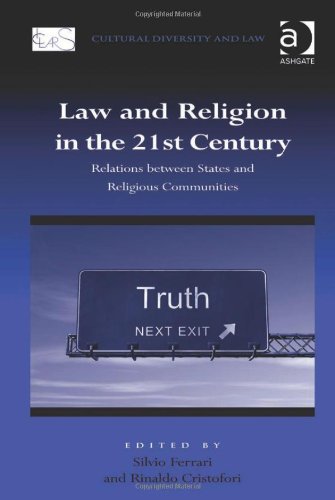
Ashgate has published S Ferrari and R Cristofori (eds), Law and religion in the 21st century: relations between states and religious communities (2010).

This book brings together leading international scholars of law and religion to provide an overview of current issues in State-religion relations. The first part of the collection offers a picture of recent developments in key countries and regions. The second part is focused on Europe and, in particular, on the Nordic States and the post-communist countries where State-religion systems have undergone most profound change. The third and final part is devoted to four issues that are currently debated all over the world: the relations between freedom of expression and freedom of religion; proselytism and the right to change religion; the religious symbols; and the legal status of Islam in Europe and Canada.
 
The work will be a valuable resource for academics, students and policy-makers with an interest in the interaction between law and religion.

The contents include:
  • A perspective from the sociology of religion, Grace Davie
  • State and religion in South Africa: open issues and recent developments, Lourens M. du Plessis
  • States and religions in West Africa: problems and perspectives, Fatou Kiné Camara
  • Religious communities and the state in modern India, Tahir Mahmood
  • State and religion in Japan. Yasukuni Shrine as a case study, Hiroaki Kobayashi
  • Religion and the state in the United States at the turn of the 21st century, W. Cole Durham Jr and Robert T. Smith
  • Religions and law: current challenges in Latin America, Juan Navarro Floria
  • State and religion in Europe, Giuseppe Casuscelli
  • States and religions in post-Communist Europe, Giovanni Barberini
  • The recent developments of church-state relations in Central Europe, Balázs Schanda
  • Church and state relations in the Czech Republic and in Slovakia, Antonello De Oto
  • States and churches in Northern Europe: achieving freedom and equality through establishment, Marco Ventura
  • Not even believing in belonging: states and churches in 5 North-European (post) Lutheran countries, Lisbet Christoffersen
  • Church and state in the United Kingdom: anachronism or microcosm, Mark Hill
  • Protection against religious hatred under the United Nations ICCPR and the European Convention system, Jeroen Temperman
  • Religious freedom and freedom of expression in France, Blandine Chélini-Pont
  • Limits and Guarantees of a Debated Right: Proselytism and the right to change religion, Asher Moaz
  • Proselytism and the right to change religion in Islam, Roberta Aluffi Beck-Peccoz
  • Proselytism and the right to change religion in Israel, Aviad Hacohen
  • Proselytism and the right to change religion: the Romanian debate, Nicolae V. Dura
  • Religious symbols: an introduction, Malcolm D. Evans
  • Religious symbols between forum internum and forum externum, Peter Petkoff
  • A brief introduction on the religious symbols debate in Italy and the United States, Adelaide Madera
  • The European Court of Human Rights on religious symbols in public institutions – a comparative perspective: maximum protection of the freedom of religion through judicial minimalism?, Hans Martien Th.D. ten Napel and Florian H.K. Theissen
  • Civil religion and religious symbols in public institutions in Russia, Elena Miroshnikova
  • The current debate on Islam, Mathias Rohe
  • Canadian Muslim women and resolution of family conflicts: an empirical qualitative study (2005–2007), Anne Saris and Jean-Mathieu Potvin
  • The implementation of the 1992 agreement in Spain, Carmen Garcimartín
  • Islam at the threshold, Andrea Pin
  • Conclusion, Silvio Ferrari