22 August 2012

NOTICE: Jewish Law and more (apologies for the strange fonts and backgrounds)


These two new books on Jewish law (and legaql pluralism) might be of interest:

Steven H Resnicoff, Understanding Jewish Law (Lexis Nexis, 2012). The book:
  • Provides critically important contextual information for any course or seminar in Jewish law; 
  • Identifies Jewish law fundamental assumptions, including an individual's responsibilities to and for others; 
  • Presents a clear, concise overview not only of Jewish law's institutions, but also of the hierarchies of its literary and human authorities; 
  • Differentiates between Jewish law's biblical and non-biblical precepts, explaining their distinct practical and theoretical consequences; 
  • Focuses on the processes through which Jewish law unfolds and the roles played by individual autonomy; 
  • Compares and analyzes the interrelationships between Jewish and secular law in several key areas, including legal ethics, bankruptcy law, and alternative dispute resolution; 
  • Through nine appendices, offers a wealth of material designed to enable students to comprehend Jewish law literature and to engage in Jewish law research. Among many other things, these appendices: (1) Prepare students for the various ways in which Hebrew and Biblical Aramaic words are transliterated; (2) Direct students to a treasury of essential resources, including English translations of primary Jewish law literature that are available, many of which for free on the internet; (3) Describe pertinent English journals, databases and books. 

Hanina Ben-Menahem, Arye Edrei, and Neil S Hecht (eds), Windows onto Jewish Legal Culture: Fourteen Exploratory Essays (Routledge, 2012):

This book opens windows onto various aspects of Jewish legal culture. Rather than taking a structural approach, and attempting to circumscribe and define ‘every’ element of Jewish law, Windows onto Jewish Legal Culture takes a dynamic and holistic approach, describing diverse manifestations of Jewish legal culture, and its general mind-set, without seeking to fit them into a single structure.
Jewish legal culture spans two millennia, and evolved in geographic centers that were often very distant from one another both geographically and socio-culturally. It encompasses the Talmud and talmudic literature, the law codes, the rulings of rabbinical courts, the responsa literature, decisions taken by communal leaders, study of the law in talmudic academies, the local study hall, and the home. But Jewish legal culture reaches well beyond legal and quasi-legal institutions; it addresses, and is reflected in, every aspect of daily life, from meals and attire to interpersonal and communal relations. Windows onto Jewish Legal Culture gives the reader a taste of the tremendous weight of Jewish legal culture within Jewish life.
Among the facets of Jewish legal culture explored are two of its most salient distinguishing features, namely, toleration and even encouragement of controversy, and a preference for formalistic formulations. These features are widely misunderstood, and Jewish legal culture is often parodied as hair-splitting argument for the sake of argument. In explaining the epistemic imperatives that motivate Jewish legal culture, however, this book paints a very different picture. Situational constraints and empirical considerations are shown to provide vital input into legal determinations at every level, and the legal process is revealed to be attentive to context and sensitive to cultural concerns.
Note, too, other new Routledge titles, including many on comparative law and legal systems, at http://www.routledge.com/catalogs/research_in_law_and_law_society_2012/.

NOTICE: New German Law Journal/Symposium


The latest issue of the German Law Journal: 
Review of Developments in German, European and International Jurisprudence, is out. 


It includes the following articles:

  • Marriage, Same-Sex Partnership, and the German Constitution - Anne Sanders
  • Freeze-Out Transactions in Germany and the U.S.: A Comparative Analysis - Christian A. Krebs
  • Negative and Positive Integration in EU Economic Law: Between Strategic Denial and Cognitive Dissonance?  - Pedro Caro de Sousa
In addition, a German Law Journal Symposium will also take place soon:

Smashing the Machine: 
The Troubled Legacy of Kantorowicz's KAMPF
9-10 September 2012

A Symposium Considering Hermann Kantorowicz's Incendiary Manifesto, The Battle for Legal Science (Der Kampf um doe Rechtswissenschaft) and the Universal Struggle to 'Free Law' from Formalism

NOTICE: Comparative Law on SSRN (by way of the Irish Society of Comparative Law)

Additional articles from SSRN have been noted by our friend in the Irish Society of Comparative Law:

Koessler, James, Is There Room for the Trust in a Civil Law System? The French and Italian Perspectives (March 1, 2012)


It is argued, through the examination of two civil law jurisdictions – France and Italy, that there is room for the trust to be translated – not transplanted – into existing civil law institutions and practice. The extent to which this is the case and the most appropriate model for this introduction will be dependent on the cultural, historical and political background of each such jurisdiction.
Whilst Italy lacks a domestic trust law, it has taken advantage of the Hague Convention to develop a thriving local practice of using foreign law for Italian trusts. This effort, spearheaded by both doctrinal and jurisprudential support, has allowed the development of a consistent framework and the surmounting of the obstacles inherent in the civil law tradition. As a result of this process initiated nearly twenty years ago, these trusts can no longer be said to be ‘foreign.' A more accurate term would be ‘domesticated’ due to the distinctive features they have developed.

Whereas France has its fiducie, a sui generis institution introduced in 2007, which is structurally a trust in comparative law terms, it is, nonetheless, functionally neutered. Trusts can be based on civil institutions, as the examples of Panama and Quebec show, and it is to be hoped that the French fiducie represents such a first step and will, one day, play a similar role. In any case, recent reforms which have increased its flexibility both structurally and functionally are to be welcomed. In particular the decision, albeit unsuccessful, of the French legislature to introduce a concept of ‘economic ownership’ goes to show just how much the lines are blurring between civilian and common law traditions.

Roy Partain. "Comparative Family Law, Korean Family Law, and the Missing Definitions of Family" (HongIk University Journal of Law). June 2012. Vol. 13. No. 2.

NOTICE: New Titles from Hart Publishing


Hart Publishing has recently published the following:
  • Cases, Materials and Text on Property Law - Edited by Sjef van Erp and Bram Akkermans
  • EU Constitutional Law - Allan Rosas and Lorna Armati
  • Ideas and Debates in Family Law - Rob George
  • International Economic Law in the 21st Century - Ernst-Ulrich Petersman
  • International Investment Law - Surya P Subedi
  • Labour Law - Simon Deakin and Gillian S Morris
  • Law and Justice on the Small Screen - Edited by Peter Robson and Jessica Silbey
  • Rights in Divided Societies - Edited by Colin Harvey and Alex Schwartz
  • The Constitution of China - Qianfan Zhang
  • The Constitution of Malaysia - Andrew Harding

A complete list of new titles, with additional information, is available at http://www.hartpub.co.uk/books/newtitles.asp.

15 August 2012

NOTICE: American Society of Comparative Law Panels on You Tube

I came across the following series of recent panels on comparative law, part of the 2011 Annual Meeting of the American Society of Comparative Law, on Youtube:
logoThis session addressed the objectives and contents of the basic course in comparative law. Doing so forces one to confront the fundamental questions of why students should study comparative law and whether there is an essential core to the field of which any serious student should be aware. Is the goal of comparative law to examine differences and similarities in discrete subjects of private and/or public law from which students might better understand the competing policies and rule choices in specific fields? Or, is the goal to understand competing legal systems and underlying modes of thought (e.g., common law, civil law, and non-Western traditions, such as Islamic law) from which might flow discussions of the underlying nature of law and legal order? Or, is the essential core to understand the methods by which scholars in different legal systems can compare one with another (as well as the inherent limitations on such comparisons)? How should the objectives of the course change in the future, and how should basic courses in comparative law change in to meet these goals?

NOTICE: Finnis on the Philosophy of Law (what else?)

The natural lawyer and legal philosopher John Finnis (Oxford/Notre Dame) has just published 'What is the Philosophy of Law?' in (2012) 1 Rivista di Filosofia del Diritto 67, part of a number of interesting papers on the topic. The abstract reads:

Copertina The philosophy of law is not separate from but dependent upon ethics and political philosophy, which it extends by that attention to the past (of sources, constitutions, contracts, acquired rights, etc.) which is characteristic of juridical thought for reasons articulated by the philosophy of law. Positivism is legitimate only as a thesis of, or topic within, natural law theory, which adequately incorporates it but remains transparently engaged with the ethical and political issues and challenges both perennial and peculiar to this age. The paper concludes by proposing a task for legal philosophy, in light of the fact that legal systems are not simply sets of norms.

The paper is available in the Notre Dame Legal Studies and Oxford Legal Studies Research series on SSRN.

NOTICE: Religare publications and events

The first publication in the Ashgate Religare series has been published: Katayoun Alidadi, Marie-Claire Foblets, and Jogchum Vrielink (eds) A Test of Faith? Religious Diversity and Accommodation in the European Workplace. It's described as:

A Test of Faith? Issues of religious diversity in the workplace have become very topical and have been raised before domestic courts and the European Court of Human Rights. Examining the controversial and constantly evolving position of religion in the workplace, this collection brings together chapters by legal and social science scholars and provides a wealth of information on legal responses across Europe, Turkey and the United States to conflicts between professional and religious obligations involving employees and employers.

The contributors examine how case law from the European Court of Human Rights, domestic experiences and comparative analyses can indicate trends and reveal established and innovative approaches. This multi-perspective volume will be relevant for legal practitioners, researchers, academics and policy-makers interested in human rights law, discrimination law, labour law and the intersection of law and religion.

Silvio Ferrari and Sabrina Pastorelli (eds), Religion in Public Spanes: A European Perspective (2012) will also be published shortly.


NOTICE: Comparative Law Review


A special issue of the Comparative Law Review, focusing on ‘The Third Globalization of Legal Thought’, was posted in the spring. Like all of its articles, these are available online. (2012) 3:1 Comparative Law Review includes:

  • John Henry Schlegel - Together Again
  • Catharine Wells - Beyond bed and bread: making the African State through Marriage Law Reform - Thoughts on Duncan Kennedy's Third Globalization
  • Sylvia Wairimu Kang’Ara - Constitutive and Transformative influences of Anglo-American legal thought
  • Jorge L. Esquirol - The “Three Globalizations” in Latin America
  • Aya Gruber - Duncan Kennedy's Third Globalization, Criminal Law and the Spectacle
  • Amy J. Cohen - ADR and some thoughts on the social in Duncan Kennedy's Third Globalization of legal thought
  • Justin Desautels-Stein - Experimental pragmatism in the Third Globalization
  • Giovanni Marini - Taking comparative law lightly. On some uses of comparative law in the Third Globalization
  • Barbara Muszyńska, Petra Nováková, and Wibo van Rossum - Fighting corruption in Polish and Czech legal cultures
  • Antonina Peri - Judicial independence vs. judicial accountability. Judicial selection models for Constitutional Courts. A comparative analysis
The previous issue, (2011) 2:2 Comparative Law Review, included the following:

14 August 2012

NOTICE: Palmer on Mixed Jurisdictions Worldwide

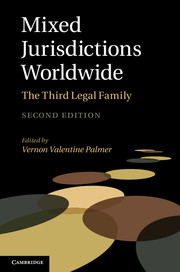
To my embarassment, I've somehow forgotten to mention the publication--a little over a month ago--of a second edition of Vernon Palmer, Mixed jurisdictions worldwide: the third legal family (2012):
Mixed Jurisdictions Worldwide 
This examination of the mixed-jurisdiction experience makes use of an innovative cross-comparative methodology to provide a wealth of detail on each of the nine countries studied. It identifies the deep resemblances and salient traits of this legal family, and the broad analytical overview highlights the family links while providing a detailed individual treatment of each country which reveals their individual personalities.

This updated second edition includes two new countries (Botswana and Malta), and the appendixes explore all other mixed jurisdictions and contain a special report on Cameroon.

The contents include:

Part I        Introduction and comparative overview
  • Introduction to the mixed jurisdictions - Palmer
  • A descriptive and comparative overview - Palmer

Part II       The comparative evidence
  • The Republic of South Africa - C. G. Van Der Merwe, Jacques du Plessis, Marius de Waal, Reinhard Zimmermann, and Paul Farlam
  • Scotland - Elspeth Reid
  • Louisiana - Palmer and Harry Borowski
  • Quebec - Michael Mcauley
  • Puerto Rico - Luis Muñiz-Argüelles
  • The Philippines - Pacifico Agabin
  • Botswana - Charles Fombad
  • Malta - Biagio Andó, Kevin Aquilina, J. Scerri-Diacono, and David Zammit
  • Israel - Tamar Gidron
Conclusions - Palmer

Appendix A    Questionnaire
Appendix B    Other mixed jurisdictions of the world
Appendix C    Special report on Cameroon

Our members will want to own this.

13 August 2012

NOTICE: Comparative Law on SSRN (by way of the Irish Society of Comparative Law)


Additional articles from SSRN have been noted by our friend in the Irish Society of Comparative Law:

Ryan, Daniel P., Essential Principles of Contract and Sales Law in the Northern Pacific: Federated States of Micronesia, the Republics of Palau and the Marshall Islands, and United States Territories (January 29, 2009). Ave Maria International Law Journal, Vol. 1, No. 1, 2009.


The Northern Pacific region, which includes Micronesia, the State of Hawaii, the American territories of Guam, the Commonwealth of the Northern Mariana Islands and American Samoa, and the Republics of Palau and the Marshall Islands, either follows or are heavily influenced by the Anglo-American common law tradition and statutes governing contract and sales. Islands in this region have made efforts to adopt recognized uniform international contract standards, particularly the Restatement (Second) of Contracts, but customary law and traditional rights still have a significant impact upon the development of contract and sales law creating a unique amalgam of substantive law in the Northern Pacific region.

The author includes a comparison to contract and sales law that is prevalent in the United States and applicable in its Northern Pacific State of Hawaii and in its Pacific territories of Guam, American Samoa, and the Commonwealth of the Northern Mariana Islands. Other U.S. territories in the Northern Pacific including Midway, Wake, Johnston Atoll, Baker, Howland and Jarvis, Palmyra, and Kingman are outside the scope of his anaylsis. The article emphasizes divergence, and highlights regional anomalies in the substantive law of contract and sales. It also examines the inter-relationship between customary and traditional law and the law of contract and sales. This anthropological approach highlights how regional custom and traditional law have interacted with Anglo-American concepts of contract and sales law to produce a unique blend of contract and sales law in this Northern Pacific region.

The author notes two significant developments; 1) that the American Law Institute’s Restatements of Law have been elevated from simply persuasive authority to the rule of decision in some of these Pacific Island nations, and 2) that the anthropological implications of local custom and traditional law in substantive contract and sales law have created a unique regional amalgam.

Dusollier, Severine, Pruning the European Intellectual Property Tree - In Search of Common Principles and Roots (April 10, 2011). Constructing European Intellectual Property: Achievements and New Perspectives, C. Geiger, ed., Edward Elgar Publishing, 2012.