03 December 2010

NOTICE: O’Brien Fellowships for Human Rights and Legal Pluralism


The McGill Centre for Human Rights and Legal Pluralism has announced O’Brien Fellowships for Human Rights and Legal Pluralism

The O’Brien Fellowship was established in 2005 through a very generous gift from David O’Brien (BCL ’65) for outstanding graduate students studying in the area of human rights and legal pluralism in the Faculty of Law.

The Fellowship is Awarded annually by the Graduate and Postdoctoral Studies Office upon recommendation of the Faculty of Law. Fellows become members of the Centre for Human Rights and Legal Pluralism.

Application deadline: January 15.

Value

Maximum $25,000 per annum, renewable once for LL.M., twice for D.C.L. (if eligibility is maintained). Renewal for a second and, if applicable, third year is subject to maintaining good standing in the program and providing a satisfactory progress report.

To find out more

To find out more about the conditions of eligibility, selection criteria, and application procedure, and to download the application forms, see McGill Graduate Law Admissions: Financial help: O'Brien Fellowships.

Hat tip to the Legal History Blog.

02 December 2010

NOTICE: A Quick Recap of our Catania Roundtables


Juris Diversitas recently co-organised two successful roundtables in Catania:


  • The first focused on the Mediterranean Hybridity Project (MHP), launched in Malta in June 2010 and co-organised with Juris Diversitas. The MHP involves the creation of a collaborative interdisciplinary network to study both state laws and other non-state norms in the region. The aim is to create, at a minimum, jurisdictional reports resulting in a published collection. Discussion at the roundtable centred on the selection of participants and the discussion of the questionnaire to be used. It was also decided that both English and French would be the working languages of the project and that additional participants would be sought. Especially important is the inclusion of individuals with social science backgrounds and scholars from the Levant and North Africa.
  • The second roundtable focused on what is now called the Legal Philosophy in Context Project (LPCP). The LPCP will investigate legal theory in historical, comparative, and social contexts. Similar to the MHP, this will be accomplished through jurisdictional reports prepared on the basis of a questionnaire prepared by the project leaders and will result in a published collection. Now a Juris Diversitas project, additional participants specialising in legal philosophy are being sought.

Individuals or institutions seeking additional information or interested in participating or sponsoring our work should contact Dr Seán Patrick Donlan (sean.donlan@ul.ie).

Please feel free to circulate this message to other individuals, institutions, blogs, etc.

01 December 2010

REMINDER: Pluri-Legal Discussion Group

Members are reminded that the Pluri-Legal Group might be of interest.

Pluri-Legal is an e-mail discussion group on JISCmail devoted to issues regarding the legal accommodation of cultural, ethnic and religions minorities in Europe.

You can join by going to www.jiscmail.ac.uk/PLURI-LEGAL.

NOTICE: Comparative Studies in Society and History

A recent issue of (2010) 52:3 Comparative Studies in Society and History had a number of law-related articles that might be of interest to members. It contained the following:
  • Editorial ForewordComparative Studies in Society and History
  • Hussein Ali Agrama, Secularism, Sovereignty, Indeterminacy: Is Egypt a Secular or a Religious State?
  • Nandini Chatterjee, English Law, Brahmo Marriage, and the Problem of Religious Difference: Civil Marriage Laws in Britain and India
  • James McDougall, The Secular State's Islamic Empire: Muslim Spaces and Subjects of Jurisdiction in Paris and Algiers, 1905-1957
  • Joyce Dalsheim, On Demonized Muslims and Vilified Jews: Between Theory and Politics
  • Jhaled Furani, Said and the Religious Other
  • Gregory Starrett, The Varieties of Secular Experience
  • Kabir Tambar, The Aesthetics of Public Visibility: Alevi Semah and the Paradoxes of Pluralism in Turkey
  • John R Bowen, Secularism: Conceptual Genealogy or Political Dilemma?
There are also a number of interesting book reviews in the issue as well. The latest issue is also available online (for a fee).

26 November 2010

NOTICE: Law and Society Association Collaborative Research Networks


Members might be interested in the Law and Society Association's Collaborative Research Networks:


Collaborative Research Networks (CRNs) were originally developed, with the assistance of a grant from the National Science Foundation, at the 2000 Annual Meeting in Miami to facilitate international research collaboration in selected topics for presentation at the meeting in Budapest in July 2001.

After those meetings, some CRNs decided to continue and build on their success by expanding their network of scholars. Many new CRNs have since been developed and CRNs have become an significant and integral component in Annual Meetings. Many organize several thematic sessions for each Annual Meeting as well as use the occasion to hold business meetings.

A CRN Coordinator is appointed by the LSA President to coordinate existing CRNs and accept proposals for new ones.

The Networks include:
  • African Law and Society
  • Biotechnology, Bioethics and the Law
  • British Colonial Legalities
  • Cause Lawyering
  • Citizenship and Immigration
  • Civil Justice and Disputing Behavior
  • Collective Human Rights
  • Critical Research on Race and the Law
  • The Cultural Lives of Capital Punishment
  • Culture, Society, and Intellectual Property
  • East Asian Law and Society
  • Feminist Legal Theory
  • Gender and Judging
  • Gender, Sexuality and Law
  • Integrating Gender into Legal Education
  • International Human Rights
  • International Socio-Legal Feminisms
  • Labor Rights
  • Language and Law
  • Law and Counter-Hegemonic Globalization
  • Law and Indigeneity
  • Law and Public-Private Dichotomy
  • Law and Social Movements
  • Law and Social Theory
  • Lay Participation in Legal Systems
  • Law, Society and Taxation
  • Legal Complex and Struggles for Political Liberalism
  • Legal Geography
  • Prisons and Prisoners
  • Private Practice Lawyers
  • Public Opinion and the Courts
  • Realist and Empirical Legal Methods
  • Regulatory Governance
  • Rule of Law, State Building and Transition
  • South Asia
  • Teaching in Law and Society
  • Transnational Legal Orders

CALL FOR PAPERS: Annual Meeting of the Law and Society Association (2-5 June 2011)


San Francisco, California USA
June 2-5, 2011
Call for Participation
Proposal Due Date: December 8, 2010

The 2011 Annual Meeting of Law and Society Association, Thursday, June 2, through Sunday, June 5, in San Francisco, CA USA.

City
Theme: Oceans Apart? Narratives of (Il)Legality in Liminal Locations

Law and Society scholars have consistently challenged both the fit and the applicability of these and other binaries, questioning what citizenship status, class, race, or politics really mean in myriad contexts. However, early in a new decade (and new century), many law and society scholars find ourselves in somewhat of a liminal space, facing whole new sets of border crossings, blurring boundaries, empirical challenges, and conceptual conundra. For example, in the U.S., the continued growth of mass incarceration coupled with the extended reach of criminal law and “civil” municipal regulations have destabilized entire communities, where categories of “incarcerated” and “free” are no longer clearly distinguishable. Around the world, political and legal responses to human migration have broken down lines between immigration law, economic regulation, and criminal justice in complex and often troubling ways.

As a result of these kinds of boundary dissolutions, notions about citizenship, sovereignty, illegality, and rights (to name a few) have all been complicated, challenging a number of longstanding assumptions underlying legal scholarship. How does the law in its many forms help or hurt the resulting conversations? The theme of the 2011 LSA Meeting–Oceans Apart? Narratives of (Il)legality in Liminal Locations–invites us to ponder the shifting and dissolving boundaries around us, empirical and conceptual, and also what they may tell us about law’s relevance, and limitations, in shaping our global future. It is fitting that we begin this exploration in San Francisco, one of the great transnational cities in the world. San Francisco, with its proximity to the Pacific Ocean, is located in a state that borders Mexico (and once was part of that nation), and which was once traversed only by native peoples. This locale is subject to tectonic forces, literal as well as environmental and social, which shape the human uses of law and responses to law. San Francisco constitutes an ideal setting for convening scholars who are concentrating their efforts on these issues.

24 November 2010

NOTICE: (2010) 3 Journal of Civil Law Studies


The Center of Civil Law Studies announces the publication of Volume 3 of the Journal of Civil Law Studies (JCLS). Volumes 1, 2, and 3 of the JCLS are freely accessible online, at www.law.lsu.edu/jcls.


Volume 3 of the JCLS contains the papers of the Saúl Litvinoff Civil Law Workshop Series. The general theme was Civil Law and Common Law: Cross Influences, Contamination, and Permeability.

  • Foreword, Olivier Moréteau & Ronald Scalise Jr.
  • An Introduction to Contamination, Olivier Moréteau
  • Don Saúl Litvinoff (1925-2010), Agustín Parise & Julio Romañach Jr.
  • Foundations for a Revival of the Case Method in Civil Law Education, Fernando M. Toller
  • The Vienna Sales Convention (CISG) between Civil and Common law–Best of all Worlds?, Ulrich Magnus
  • Legal Theory and the Variety of Legal Cultures, Sheldon Leader
  • The Reform of Legal Education in China and Japan: Shifting from the Continental to the American Model, Xiangshun Ding
  • Press Freedom in Indonesia: A Case of Draconian Laws, Statutory Misinterpretation, but still one of the Freest in Southeast Asia, Nono Anwar Makarim
  • Common Law, Civil Law, and the Challenge from Federalism, Santiago Legarr
  • The Principle of Proportionality: The Challenges of Human Rights, Juan Cianciardo
  • Academic Legal Writings by Saúl Litvinoff

23 November 2010

NOTICE: Palmer on the Louisiana Supreme Court


Professor Palmer has just informed me of his 'corrected' study of the Louisiana Supreme Court. Both Louisianians and non-Louisianians will find it interesting. - SPD

Dear Colleagues, I am pleased to inform you that my corrected study has just been published in Global Jurist (Berkeley Press). Please see my covering “note” to the reader below, and you may access the article without charge through the links indicated.

Best wishes, Vernon

New Corrected Study on the Louisiana Supreme Court
and Campaign Contributions
Published in Global Jurist - November, 2010.
Read the Article in Global Jurist

A Note from the Author - Vernon Palmer:

It is the duty of a scholar, I believe, to admit and correct his errors. The important thing is to set the record straight and to advance the truth.

In that spirit I am presenting my latest publication, The Recusal of American Judges in the Post-Caperton Era: An Empirical Assessment of the Risk of Actual Bias in Decisions Involving Campaign Contributors. This new article expands upon and carefully corrects my previous study published in the Tulane Law Review (2008) concerning the influence of campaign contributions on the Louisiana Supreme Court. The previous study was sharply criticized by the Justices who pointed out a number of errors in the data and called for corrections and an apology.

After two years of painstaking research and rechecking, here are my republished results.

The striking thing is that the overall conclusions of the first study remain basically unchanged. Furthermore, the calculations have been independently confirmed and replicated by an outside research institute. Thus the present study rests not only on a strong foundation but it reaffirms the general finding that the Court’s refusal to recuse itself in campaign contributor situations is a threat to the court’s own impartiality and reveals a risk of actual bias.

The findings are summarized on pp. 6-9 of the text. Among other things they show the Court, as a whole, votes for its contributors on average about 65% of the time (in nearly two out of three cases); individually, certain Justices greatly exceed 65%. One Justice voted for his contributors’ side of the case 100% of the time. That percentage reflects a serious risk of actual bias. There is also evidence of similar risk when the Court faced contributors on both sides of the case. The voting of certain Justices was anomalous. They sharply favored the larger of the two contributors, regardless of the side he was on, and though it contrasted with their general voting tendency when no money was involved.

The expanded investigation also brings to light, for the first time, detailed data about the occult and little-known practice of accepting campaign contributions from litigants in cases under deliberation. The data reveal that a number of Justices vote for the position of their sub judice contributors 100% of the time. This has an appearance of impropriety and also reflects a significant risk of actual bias.

© 2010 - Vernon Palmer

20 November 2010

NOTICE: Feliu, Kim-Prieto, and Miguel on the Spanish Roots of Louisiana Civil Law

Vicenç Feliú, Dennis Kim-Prieto, and Teresa M Miguel have written "A Closer Look: A Symposium Among Legal Historians and Law Librarians to Uncover the Spanish Roots of the Louisiana Civil Law":

The debate regarding whether the origin of Louisiana civil law is based in the Spanish or in the French legal tradition has been ongoing since that state’s incorporation into the United States as a result of the Louisiana Purchase. Distinguished legal scholars have argued in favor of one tradition being dominant over the other, and each has been staunch in support of that view. This article proposes and demonstrates that the Spanish, not French, civil law had an enormous influence on the creation and evolution of Louisiana civil law, and that this legacy resonates today.

The article begins with a brief historical account of the formation of Louisiana from territory to statehood. It then closely examines the contributions of Louis Casimir Elisabeth Moreau Lislet, the architect of the Digest of 1808 and the Code of 1825. Original Spanish documents and resources that were the foundation of the Digest of 1808 are analyzed and used to demonstrate how these Spanish civil law sources had a profound impact on Moreau Lislet and on the creation of Louisiana civil law. Finally the continuing evolution of Louisiana civil law and the now-famous Batiza-Pascal debate on the origins of the Louisiana civil law are carefully examined.

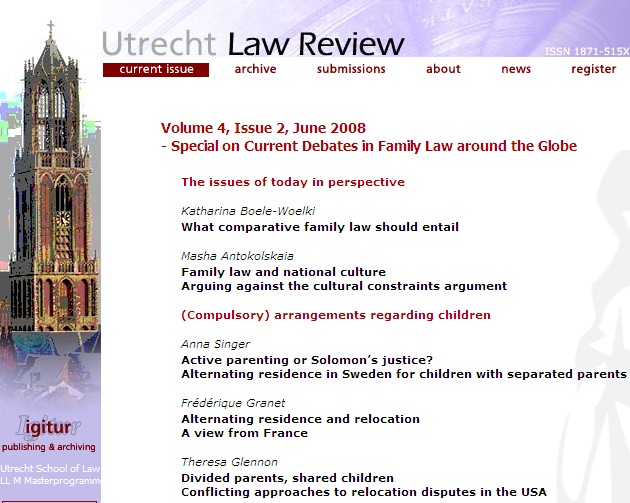
NOTICE: Utrect Law Review

Note that the (2010) 6:3 Utrecht Law Review is now available.

It's a special issue on Euroscepticism and Multiculturalism. It contains the following:

Frank van Schendel, Irene Aronstein
Introduction – Euroscepticism and multiculturalism

Veit Bader
Constitutionalizing secularism, alternative secularisms or liberal-democratic constitutionalism? A critical reading of some Turkish, ECtHR and Indian Supreme Court cases on ‘secularism’

Leonard F.M. Besselink
National and constitutional identity before and after Lisbon

Ruth Sefton-Green
Multiculturalism, Europhilia and harmonization: harmony or disharmony?

Jan M. Smits
Beyond Euroscepticism: on the choice of legal regimes as empowerment of citizens

Esin Örücü
Diverse cultures and official laws: multiculturalism and Euroscepticism?

Irene Aronstein
‘The Union shall respect cultural diversity and national identities’ Lisbon’s concessions to Euroscepticism – true promises or a booby-trap?