Showing posts with label commercial law. Show all posts

09 February 2023

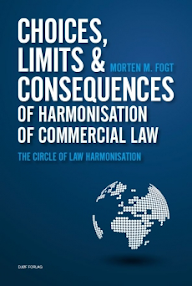
Choices, Limits and Consequences of Harmonisation of Commercial Law - The Circle of Harmonisation Law


Choices, Limits and Consequences of Harmonisation of Commercial Law - The Circle of Harmonisation Law

Morten Midtgaard Fogt


The harmonisation of private commercial law and the application of the various instruments of harmonisation are becoming increasingly complex. New formal or informal means of harmonisation are added to the panorama of harmonisation instruments and new actors, be it at global, regional or national level, are introduced as well. Regional harmonisation sets its footprint both internally and externally. Innovative (or reintroduced) methods and phenomena for the harmonisation of commercial law have been suggested. Still, the most important and dominant means of harmonisation are the traditional multilateral conventions, the flexibility of which have been improved by different types of reservations and review and/or revision clauses. Taken together, the harmonisation process with its various and different means constitutes a circle of law harmonisation, in which circle there is an interaction between, and reciprocal influence of, all the various formal or informal means of harmonisation.

This book analyses the process of law harmonisation with the focus on choices, limits and consequences and uses in particular the CISG and Cape Town Conventions as examples. It takes into account means, methods, role of old and new actors, principles of interpretation and gap-filling, impact of judicial bodies and their law-finding and possible law-making function.

An important issue, which transcends the work, is how to strike the balance between the harmonisation by formal means of legislation and the creative law-making role of jurisprudence and doctrine in order to accommodate the promotion of a dynamic and continued progress in the harmonisation, the necessary degree of predictability and legal certainty, and a clear distinction from the otherwise non-harmonised applicable national law.

21 February 2022

International Journal for the Semiotics of Law - Call for Papers

International Journal for the Semiotics of Law -  Call for Papers

Special Issue on :

International Arbitration 
in the Digital World


Guest Editors: 
Vijay K. Bhatia, Chinese University of Hong Kong 
Magdalena Łągiewska, University of Gdańsk, Poland 

This call for papers is intended to exchange views in the field of international commercial arbitration with a focus on law, language, and communication in the digital world. The aim of the intended special issue is to promote a comprehensive and cutting-edge analysis of recent developments, issues, and challenges in the field. 

The COVID-19 pandemic has significantly impacted the dispute resolution landscape, including international arbitration. Therefore, instead of traditional functioning of arbitral tribunals, the COVID-19 pandemic accelerated the entire process of digitalization and paved the way for further development of online arbitration. It seems that the digitalization (i.e., collecting of e-evidences, online hearing, etc.) has become an inevitable process and will have an impact on the global arbitration systems and practices. This begs the question of whether the online hearings and e-platforms comply with the cybersecurity measures. Do they guarantee the data protection of e-evidences? What are the specific solutions adopted by the international commercial and investment arbitral institutions worldwide? What kind of impact this has on the discursive construction of discourses of arbitration? What are the implications of social media on some of the key aspects of arbitration, such as privacy, authenticity, and transparency? In addition, there are new trends emerging in international arbitration such as third-party funding, arb-med-arb mechanisms and new types of disputes that could be handled by arbitral tribunals, such as Environmental, social and governance (ESG) issues, and technology disputes, such as those involving cryptocurrency, blockchain, and artificial intelligence. These are some of the key developments that we would like to explore in the proposed issue of International Journal for the Semiotics of Law. 

The special issue will focus on both theoretical as well as practice-based approaches to international arbitration, based on a comprehensive and cutting-edge analysis across different legal systems with a special focus on recent developments, issues, and challenges facing the alternative dispute resolution institutions. We specifically invite submissions with a focus on 2 issues covering law, language, and communication in arbitration contexts including, but not necessarily limited to, the following: 
•   Digitalization in international commercial and investment arbitration, 
•   Third-party funding in international commercial and investment arbitration, 
•   New types of disputes handled by arbitral tribunals, 
•   Discursive construction of arbitration processes in various digital modes. 

Submissions following these themes as well as other possible ways of analysis related to the above topics should be submitted to 
-   Magdalena Łągiewska (magdalena.lagiewska@ug.edu.pl),
and 
-   Vijay K. Bhatia (vjkbhatia1@gmail.com). 

Maximum length: no longer than 10,000 words, including footnotes, summary, references etc. 
•   Deadline for Abstracts (Max 500 words):       30th August 2022 
•   Decisions on acceptance:                             31st October 2022 
•   Deadline for full papers:                               30th of April 2022

25 October 2019

New Publications at Oxford University Press


New Publications at Oxford University Press


Dear all,

Please find below a list of recent and upcoming titles from Oxford University Press which are available for review in journals, blogs, and websites. Also included are links to their pages on the OUP website, where you can learn more about what they contain.

Please respond to this email if you would like to receive any of these titles for review, detailing to whom and where you would like them delivered.


New Law titles available for review:

Commercial Law

Cryptoassets
Legal, Regulatory, and Monetary Perspectives
First Edition
Edited by Chris Brummer

A Guide to the IBA Rules on the Taking of Evidence in International Arbitration
Roman Khodykin and Carol Mulcahy
Consultant Editor Nicholas Fletcher QC

International Copyright
Principles, Law, and Practice
Paul Goldstein and P. Bernt Hugenholtz

Constitutional and Comparative Law/ National Legal Systems

Unable
The Law, Politics, and Limits of Section 4 of the Twenty-Fifth Amendment
Brian C. Kalt

The Wisconsin State Constitution
Second Edition
Steve Miller and Jack Stark

EU Law

The EU Citizenship Directive: A Commentary
Second Edition
Elspeth Guild, Steve Peers, and Jonathan Tomkin

Law and Society/ Legal History/ Jurisprudence

Between Truth and Power
The Legal Constructions of Informational Capitalism
Julie E. Cohen

A History of American Law
Fourth Edition
Lawrence M. Friedman


International Law

The Battle for International Law
South-North Perspectives on the Decolonization Era
Edited by Jochen von Bernstorff and Philipp Dann

The Rise of China and International Law
Taking Chinese Exceptionalism Seriously
Congyan Cai

How International Law Works in Times of Crisis
Edited by George Ulrich and Ineta Ziemele


Please reply to this email (LawReviewRequests@oup.com) to request your review copy.
If you are not the best person to contact about book reviews for your journal or blog, or would like to receive information about another area of law please do let us know.
Best wishes,
The Law Review Request team

Our Privacy Policy sets out how Oxford University Press handles your personal information, and your rights to object to your personal information being used for marketing to you or being processed as part of our business activities.

If you do not wish to be contacted about titles for review, please respond to this email.

06 July 2018

Comparative Counter-Terrorism Law

Comparative Counter-Terrorism Law

by Kent Roach (ed.) et al.


Terrorism law is as international as it is regionally distinct and as difficult to define as it is essential to address. Given recent pressures to harmonize terrorism laws from international organizations like the United Nations Security Council, the Financial Action Task Force, and the Council of Europe, this book presents readers with an up-to-date assessment of terrorism law across the globe. Covering twenty-two jurisdictions across six continents, the common framework used for each chapter facilitates national comparisons of a range of laws including relevant criminal, administrative, financial, secrecy, and military laws. ReComparative Counter-Terrorism Lawcognizing that similar laws may yield different outcomes when transplanted into new contexts, priority of place is given to examples of real world application. Including a thematic introduction and conclusion, this book will help establish comparative counter-terrorism law as an emerging discipline crossing the boundaries of domestic and international law.
  • Includes chapters on twenty-two different legal jurisdictions representing North and South America, Asia, Africa, Europe, and Australia

  • Common framework for chapters allows for country-to-country comparison on specific legal issues

  • Includes an introduction to the emerging field of comparative counter-terrorism law and its methodology
(Subjects: comparative financial law, commercial law, comparative criminal law, administrative law, immigration law, constitutional law, military law; private international law)

15 August 2014

CONFERENCE: 2014 ABA Moscow Dispute Resolution Conference


The ABA’s sixth annual Conference on the Resolution of CIS-Related Business Disputes — A “MUST ATTEND” conference  for Litigators, Corporate Counsel,  Arbitration Practitioners, Judges, Academics, Business Executives and Policy-Makers!
Where: Radisson Royal Hotel Moscow 2/1 bid 1 Kutuzovskiy prospekt Moscow 121248 Russian Federation
Date:  September 19, 2014
Time: 8:00 AM - 10:00 PM AT

Topics will include:
•The Merger of the Supreme Commercial (Arbitrazh) Court and Supreme Court of General Jurisdiction:  Implications for the Administration of Justice, the Resolution of Commercial Disputes and International Arbitration in Russia
•Making CIS-Related Disputes “Stick” in Non-CIS Courts:  Addressing Personal Jurisdiction and Forum Non Conveniens
•Lawyer Ethics in Dispute Resolution: A Cross-Border Analysis of What You Can and Cannot Do
•The New Russian IP Court: Taking Stock One Year On
•Corporate Disputes in a CIS Context:  Managing Conflicts Between Successive Generations of Shareholders
•In-House Counsel Perspectives on the Resolution of CIS-Related Disputes 

Program and details here http://ambar.org/moscow2014


28 January 2014

BOOK: Mitchell's Contract Law and Contract Practice

Hart Publishing has published a new title 'Contract Law and Contract Practice. Bridging the Gap Between Legal Reasoning and Commercial Expectation' by Catherine Mitchell.

Abstract

An oft-repeated assertion within contract law scholarship and cases is that a good contract law (or a good commercial contract law) will meet the needs and expectations of commercial contractors. Despite the prevalence of this statement, relatively little attention has been paid to why this should be the aim of contract law, how these 'commercial expectations' are identified and given substance, and what precise legal techniques might be adopted by courts to support the practices and expectations of business people. This book explores these neglected issues within contract law. It examines the idea of commercial expectation, identifying what expectations commercial contractors may have about the law and their business relationships (using empirical studies of contracting behaviour), and assesses the extent to which current contract law reflects these expectations. It considers whether supporting commercial expectations is a justifiable aim of the law according to three well-established theoretical approaches to contractual obligations: rights-based explanations, efficiency-based (or economic) explanations and the relational contract critique of the classical law. It explores the specific challenges presented to contract law by modern commercial relationships and the ways in which the general rules of contract law could be designed and applied in order to meet these challenges. Ultimately the book seeks to move contract law beyond a simple dichotomy between contextualist and formalist legal reasoning, to a more nuanced and responsive legal approach to the regulation of commercial agreements.
Information on the book is here.