08 August 2013

ARTICLE: Duve on European Legal History - Global Perspectives

Thomas Duve, the Managing Director of the Max Planck Institute for European Legal History (MPIELH), has made his 'European Legal History - Global Perspectives' available on the MPIELH SSRN page. 

It's a Working Paper for the upcoming Colloquium 'European Normativity - Global Historical Perspectives' (MPIELH, 2-4 September 2013).

The abstract reads:

During the last decades, we have learned from authors like Helmut Coing, Franz Wieacker, Harold Berman, Peter Stein, Manlio Bellomo, Paolo Prodi, – to name but a few – that one of Europe’s major cultural achievements is its law, its unique legal culture. Europe, as is emphasized today not least in intercultural dialogue, or ‘the West’ have produced a wide range of cultural achievements that spread around the world: the rule of law, human rights, the differentiation between the realms of law and religion, codification techniques, etc. Yet, this historical self-reassurance has come under considerable pressure, not least through Global history, Postcolonial Studies, and Critical Legal Studies. Traditional European history is said to be Eurocentric, partial, incomplete and inadequate to the complexity of historical globalization. Even if we might not agree with this criticism: The discipline of ‚European Legal History’ has to consider these challenges. In the light of this criticism, we have to deliberate on fundamental questions about how we want to write European Legal History in the future. 

In this working paper, I would like address basically three questions: Which conception of Europe does ‘European Legal History’ hold; is it still valid for us today – and (how) can this tradition be combined with global perspectives on history? – Ultimately, I argue that we are moving from a ‘European legal history’ to a ‘Legal history (of Europe) in a global perspective’ and indicate what the latter could look like.


Highly recommended! - SPD


06 August 2013

BOOKS: New Titles from Hart Publishing

Hart Publishing has released a number of new titles, including:

Geneviève Helleringer and Kai Purnhagen, Towards a European Legal Culture

European harmonisation efforts such as a European civil code, European constitutional treaties, European principles, and European fundamental rights are frequently criticised for building on or creating a European legal culture that does not exist; in reality what we have is European legal pluralism. Some have argued that the pluralistic structure of European law hinders the development of a community, which is a necessary requirement for a European legal culture. And if there can be no common European legal culture then there is no basis for harmonising exercises.

The contributors to this book explore in different legal areas whether in fact the contrary is true. Cultural pluralism might indeed be a distinctive feature of European legal culture. Diversity is not something that is in opposition to, but rather constitutes a new, different understanding of European legal culture. The contributions demonstrate in detail how such an approach inter alia in the areas of private, corporate, administrative and constitutional law furthers understanding of a developing European legal culture, how it offers theoretical and doctrinal insights, and how it adds critical perspective.

Yuanshi Bu, Chinese Civil Law: A Handbook

China is a major civil law jurisdiction. Since the end of the 1990s great efforts have been made in China to codify the entire civil law. With the major statutes governing contracts, property, torts and conflict of laws promulgated in 1999, 2007, 2009 and 2010 respectively, the most crucial steps have been taken towards the creation of a Chinese Civil code.

This book attempts to shed light on both the theoretical and the practical aspects of Chinese civil law, while extensive footnotes and a detailed bibliography and index allow for further study of specific areas and facilitate systematic research. 

JOURNAL: (2013) 4:1 Jurisprudence

Jurisprudence logoThe latest volume of Jurisprudence has been published by Hart Publishing. 
The volume, available here, includes the following articles:

Nicola Lacey, Institutionalising Responsibility: Implications for Jurisprudence

In this paper, the author suggest that the historical and institutional conditions of existence of the concepts which animate legal argumentation - like the historical and institutional conditions of existence of certain forms of law - are of interest not only in their own right, but also because they raise methodological issues for jurisprudence. These include questions about the relationship between concepts and the social phenomena which they purport to categorise; about the relationship between philosophical and other forms of legal theory; and about how a jurisprudence largely dominated by philosophical methods may be brought into productive dialogue with other forms of theoretical analysis. Only by broadening both its horizons and its methods, the author argues, will jurisprudence be capable of illuminating not only doctrinal analysis within particular jurisdictions at particular times, but also comparative and historical scholarship.

Marco Goldoni, Montesquieu and the French Model of Separation of Powers

JURIS DIVERSITAS: Deadline - Proposals to host 2014 Conference

We've already collected several offers to host our 2014 Conference and we'll be making a decision on this soon.


If anyone else wants to offer to host the conference--with our assistance--in the early summer of 2014, please email me as soon as possible.

05 August 2013

JOURNAL: Australian Journal of Asian Law


(2013) 2:2  Australian Journal of Asian Law is now available.


Australian Journal of Asian Law  is the leading peer-edited journal of analysis, commentary and primary material on the laws, legal systems and legal cultures of Asia. It is a joint initiative of the members of the Asian Law Centre at the University of Melbourne and the Law Faculty of the Australian National University, with support and advice from Australian and international colleagues, and sponsored by the Asian Law Centre and the Australian National University. The journal provides a common forum for ideas and informed debate on current legal issues from a wide range of expert legal scholars and practitioners whose work focuses on Asia.

Table of Contents:

Genders and Genetics: The Legal and Medical Regulation of Family Forms in Contemporary Japan.
Vera Mackie, University of Wollongong - Faculty of Law, Institute for Social Transformation Research

Regulating Water Concessions in China: Towards a Transparent Pricing System.
Wei Yan, Shanghai University Law School

Legal Regulation of ‘Decent Work’: Evidence from Two Big Industries in Bangladesh.
Mia Mahmudur Rahim, Queensland University of Technology - School of Accountancy

The Establishment of Juvenile Courts and the Fulfilment of Vietnam's Obligations Under the Convention on the Rights of the Child.
 Thi Thanh Nga PHAM, University of Wollongong

Transnational Corporations and Human Rights Violations in Indonesia.
 Iman Prihandono, Airlangga University

Criminalisation of Money Laundering in the International Anti-Money Laundering Regime and its Adoption by Vietnam.
 Chat Le Nguyen, University of Canterbury

02 August 2013

JOURNAL: Law and Social Inquiry

(2013) 38 Law and Social Inquiry is now available:


ARTICLES


Botched Executions and the Struggle to End Capital Punishment: A Twentieth-Century Story
Austin Sarat, Katherine Blumstein, Aubrey Jones, Heather Richard, Madeline Sprung-Keyser and Robert Weaver


REVIEW ESSAY


JOURNAL: Settler Colonial Studies

Settler Colonial StudiesI just discovered Settler Colonial Studies, a journal that promises to be useful for the study of the diffusion of Western legal ideas and institutions around the world. 


The journal:


was established to respond to a growing demand for reflection and critical scholarship on settler colonialism as a distinct social and historical formation.


The journal aims to establish settler colonial studies as a distinct field of scholarly research. Scholars and students will find and contribute to historically-oriented research and analyses covering contemporary issues. We also aim to present multidisciplinary and interdisciplinary research, involving areas like history, law, genocide studies, indigenous, colonial and postcolonial studies, anthropology, historical geography, economics, politics, sociology, international relations, political science, literary criticism, cultural and gender studies and philosophy.


This journal will be considering original feature articles, review articles, shorter reviews, and proposals for thematic issues.


Have a look.

CALL FOR PAPERS: Contamination - Melbourne Doctoral Forum on Legal Theory


CONTAMINATION

MELBOURNE DOCTORAL FORUM ON LEGAL THEORY

MONDAY 9 & TUESDAY 10 DECEMBER 2013

CALL FOR PAPERS

The 6th Melbourne Doctoral Forum on Legal Theory will be held at the Melbourne Law School, 9-10 December 2013. This year the forum addresses contamination. It will again bring together research students and early career researchers from all disciplines and diverse fields of scholarship to engage with political, theoretical, and methodological issues engendered by law.

As a concept, contamination is organic, fluid, contagious, and affective. The grammar of contaminating law calls attention to the processes of change and becoming through which legal thought carries valence, effect and violence. And yet, contamination is inherently ambivalent. How might law alter the non-legal dimensions of life? How can the interaction between different legal orders and types of law be theorised through contamination? If contamination is already neutralised of its subversive power, what would it mean to pursue a politics of contamination against structures of domination that thrive on the symbolic idea of purity? Might law be interpreted as irreducibly pharmacological - at once medicinal and poisonous - always on guard against the horrors of an unchecked nature? What work might the unruly, irresponsible and risky body do in unmaking juridical ordering?

01 August 2013

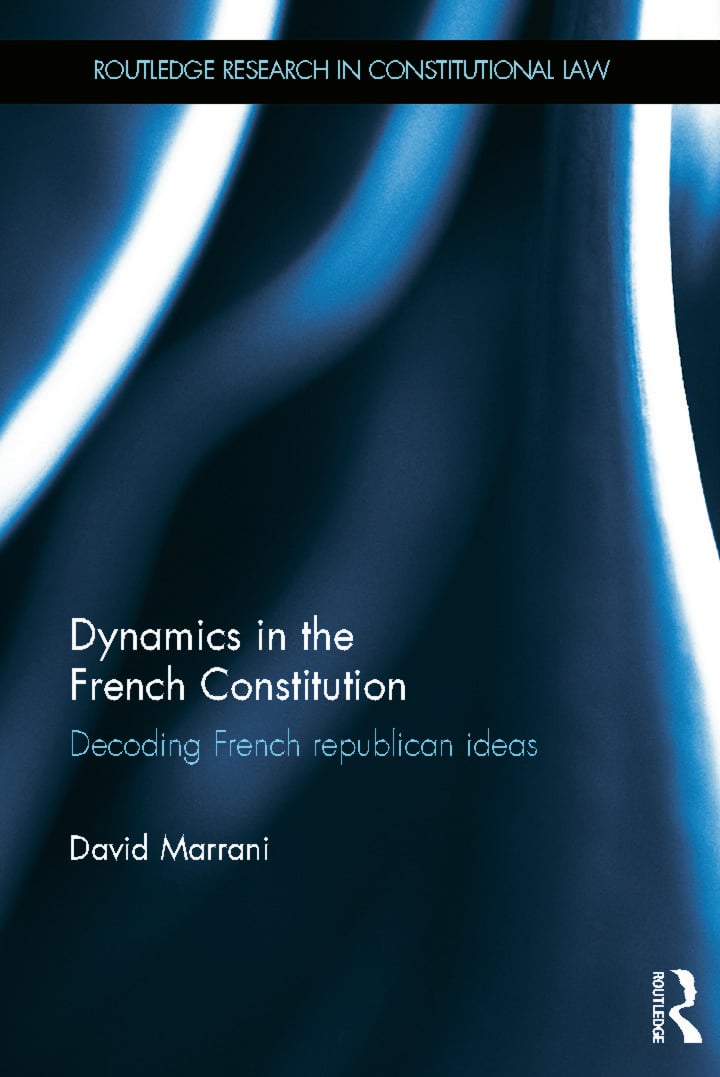
BOOK: Marrani on Dynamics in the French Constitution


David Marrani, Director of Studies at the Institute of Law - Jersey, has just published Dynamics in the French Constitution: Decoding French Republican Ideas:


The promulgation of the Fifth French Republic Constitution in 1958 marked the end of a complex constitutional history that has since 1789 seen more than twenty constitutions and five Republics. Lasting now for more than fifty years, the Fifth Republic Constitution has proven to be the right settlement for the French people; a consensual text.
However, while offering the appearance of stability, the Fifth French Republic Constitution has often been reconsidered and changed, not least in the year of its fiftieth anniversary, when the Constitution was 'modernised'. These dynamics of the Fifth Republic Constitution are neither a recent matter nor entirely the result of the successive constitutional amendments. Instead, the history of the Constitution has involved the resurgence of repressed archaic elements from the ancient regime, while the social, economic and environmental contexts have penetrated not only the text itself but more extensively its spirit, and behind it, the philosophy and our perception of the Republic.
In Dynamics in the French Constitution, David Marrani questions the foundations of the French Fifth Republic. In using specific themes, current and traditional debates, contemporary and archaic factors, that have enlightened the road of long lasting Republic, the book explores some of the changes of the last fifty years and the tensions that are present within the constitutional text. In combining theoretical concepts of constitutional law with key contemporary and historical developments, such as the European integration, the response to environmental challenges, the practice of human rights and the pillars supporting French republicanism, this book offers varied and creative tools for a better understanding of the Republic of today.

ARTICLE: Odinet on Contemporary Legal Reform, the Civil Law Tradition, and Changing Expectations

Christopher K Odinet has posted an article on Louisiana—‘The Anchor Effect: Contemporary Legal Reform, the Civil Law Tradition, and Changing Expectations’—on SSRN. The article is forthcoming in the (2014) 88 Tulane Law Review:

The struggle between making progress and preserving tradition is as old as time. On the one hand, progress is needed to move forward, to grow, to expand, to become more prosperous, and — perhaps most importantly — to prevent being left behind. On the other hand, tradition is what links us to our past, gives us a sense of history and roots, and creates a common culture that binds us all together. Louisiana law is no stranger to this struggle, and has been endeavoring to strike this perfect balance for much of its history. 

A great deal of Louisiana law is historically derived from the civil law tradition, whereas the rest of the United States follows that of the common law. As such, Louisiana is often referred to as a civil law island floating in a sea of common law jurisdictions. Nonetheless, the civil law heritage holds a special place in what makes Louisiana so distinctive, and efforts have been made over time to preserve and develop these legal treasures.