30 March 2011

NOTICE: Law and Language

The 2011 programme on Law and Language, part of the Current Legal Issues series, has been convened by Professor Michael Freeman and Dr Fiona Smith of UCL's Faculty of Law:

This interdisciplinary colloquium celebrates the wide and diverse relationship between Law and Language. Language and law are inextricably linked in many ways: rules are expressed, understood, and interpreted in language; legislation too is a special form of expression, as is a judge’s opinion. We might think too about the way we speak about law:

how does the language of rights or the language of power harness, constrain and change our perceptions of law? How language works to shape and enrich our understanding of law is also important: for example, semantics, hermeneutics, linguistics, logic, semiotics, psycholinguistics, syntax, pragmatics, each reveal deeper ideas. Analytic techniques from many other disciplines like Literature, Philosophy, Neuroscience, Economics, Geography, Anthropology and Psychology (to name but a few) each reveal new insights into the way we perceive language and law in general, how we work with language in law and how we might understand the place of language in specific areas of law, including Contract, Tort or International Law for example. The relationship between law and language extends to broader notions of language as communication too, like the crucial role of silence and non- verbal communication. In essence, the relationship between law and language is varied and complex. The ideas expressed here only touch on the many diverse ways law and language interact. The 16th Annual Colloquium of Current Legal Issues covers a broad spectrum of ideas and disciplines on the relationship between law and language.

See http://www.ucl.ac.uk/laws/language/index.shtml for additional information.

NOTICE: Tuori on Reason and WIll in Law

Ashgate has recently published, as part of their 'Applied Legal Philosophy' series, Kaarlo Tuori (Helsinki)'s Ratio and Voluntas: The Tension Between Reason and Will in Law (2011):

From the ancient beginnings of Western legal tradition, law has been conceived as traversed by a fundamental tension between power (will) and reason. This volume examines the tension between these two poles in modern law, building on the views of distinctive features of the ideal-typical mature modern legal system that was previously presented in the author's work, Critical Legal Positivism (Ashgate 2002).

NOTICE: Emerging Strategic Research Theme on Diversity Studies (University of Hong Kong)

I just received the following call for papers for on the Emerging Strategic Research Theme on Diversity Studies (University of Hong Kong). Note that the call appears to be over, but that the conference has not yet taken place:

RECOGNITION AND THE POLITICS OF IDENTITY AND INCLUSION
IN THE 21ST CENTURY: MANAGING DIVERSITY IN PLURAL SOCIETIES

28th & 29th April 2011
The University of Hong Kong

Migration has generated an increasingly borderless world which has challenged the nation-state model as an effective tool for the governance of multiplicities and the management of diversity. As the nation state is faced with the challenge of dealing with immigrants, non-nationals, refugees and others with newly emerging identities, there is a need to reassess existing frameworks for recognition of the claims of minority communities.

Whilst civil society movements over the course of the last century have helped secure legal recognition of the rights of minorities, the complexities of plural identities showcase the weaknesses of the current categorizations which form the basis for the extension or denial of rights. As a result, it is necessary to critically examine the resulting marginalization of individuals and groups on the basis of ethnicity, race, religion, nationality, national minority status, refugee status, gender, age, sexuality, health, and disability. This conference seeks to explore the changing dimensions of the politics of identity and inclusion and their implications for governance and the protection of minority communities in plural societies. It will draw on the concepts of equality, non-discrimination, identity, inclusion, minority rights and human rights to address the comprehensive challenges posed by life at the margins of society.

THEMES:

The Conference solicits papers that address any of the following themes:

1. National, Multiple and Fluid Identities: The New Politics of Identity and Recognition
2. Religion and the State: Fissured Discourses on Secularism, Accommodation and Tolerance
3. Legal Pluralism and Cultural Diversity
4. Citizenship, Participation, Inclusion and Belonging in Diverse Societies
5. Economic, Social and Cultural Rights and Inequality

PAPER SUBMISSION PROCEDURE:

People from all disciplines are invited to submit proposals for consideration. Please submit a 300 word abstract by 31 January 2011 to:

CONTACT: Puja Kapai
Email: puja@hku.hk

including the following information:

(a) Your full name
(b) Institutional affiliation
(c) Email address
(d) The relevant conference theme which your paper will address
(e) The title of your paper

Abstracts should be in Word format and the file name should be the author's full name.

The subject of the e-mail should be "Diversity Conference Abstract Submission" and should include a short CV. All submissions will be reviewed and the authors of accepted abstracts will be informed by mid-February 2011. Draft papers are due on 31st March 2011. Papers presented may be eligible for selection for publication in an edited volume.

FURTHER INFORMATION:

For further information, please visit: http://www.law.hku.hk/diversity/

25 March 2011

NOTICE: Correlations -- Law, Language and Culture

Logo
I received the following message courtesy of the Association for Political and Legal Anthropology (APLA):

Correlations: Law, Language and Culture, The Third International Summer School on the Cultural Study of the Law will be held from August 7 to August 21, 2011 in Osnabrück, Germany. Hosted by the Institute of English and American Studies, in collaboration with the University of Copenhagen, the Birkbeck School of Law at the University of London, York University, Toronto, The Jean Monnet Centre of Excellence and the European Legal Studies Institute at the University of Osnabrück, the summer school seeks to bring together graduate students from around the world to promote and examine the interdisciplinary study and research of law and culture.

During the two week program, students will partake in a unique experience of scholarly collaboration and exchange through workshops, public lectures, panel discussions, excursions and a final symposium. The School will offer a total of four workshops for 20-25 international graduate students over a two-week period. The first workshop will be concerned with basic theories, concepts and perspectives within the emerging field of cultural legal studies, focusing specifically on the range and potential of interdisciplinary studies and approaches. The remaining three workshops will focus on key areas of critical inquiry that have been central to the dynamic development of the field and are of particular importance within an European context, for example:

**The relation between human rights and cultural rights
**Towards a Culture of Rights?: Law, Literature and the Cultural Presence of the Law
**Copyright, Authorship and the 'Propertization' of Culture

Participant Eligibility: Doctoral candidates in literature, the law, the arts, the humanities, and the related social sciences are invited to apply, as are advanced students pursuing a J.D. or its equivalent (such as the L.L.B). Young scholars or junior faculty members who have received a Ph.D. or corresponding degree in the last five years are also eligible. There are openings for approximately 25 students to participate in the summer school.

Application Process: Applicants should complete:

**An application form, indicating preferred workshop that can be found at: http://www.blogs.uni-osnabrueck.de/lawandculture/admission/
**A statement of purpose no more than two pages long, describing current scholarly interests, previous research, and plans for how the Summer School would specifically further these interests and plans.
**An up-to-date curriculum vitae.

Students interested in taking part in the Summer School should submit their applications no later than April 30, 2011. Detailed information about the school, the workshops, international faculty, admission and fees can be found at: http://www.blogs.uni-osnabrueck.de/lawandculture. Please direct all inquiries about the school to our coordinator's office at lawandculture@uos.de.

23 March 2011

NOTICE: New Private Law Theory Group

I've just become aware of the Private Law Theory Group created last year.


You might have a look at their blog and keep an eye on the group.

NOTICE: Gilbert + Tobin Chair in Indigenous Law (University of Sydney)

The following is from the Legal Scholarship Network on SSRN:

THE UNIVERSITY OF SYDNEY
Sydney Law School Gilbert + Tobin Chair in Indigenous Law
Reference No. 402/0211

The University of Sydney is Australia's premier University with an outstanding global reputation for academic and research excellence. It employs over 7500 permanent staff supporting over 49,000 students.

Sydney Law School is pleased to announce the establishment of its first Chair in Indigenous Law.

The Gilbert + Tobin Chair in Indigenous Law, initially in place for five years, will provide academic leadership in the establishment of a rigorous Indigenous law program, developing generalist undergraduate and postgraduate courses in Indigenous law while enhancing the capacity of the Sydney Law School to service specialist postgraduate research.

JOB DESCRIPTION:

As Chair, you will engage with internal stakeholders including the Koori Centre; the new position of Deputy Vice-Chancellor (Indigenous Strategy & Services); the Indigenous Strategy and Services Committee.; and colleagues within the division of Law, Arts & Social Sciences, and Education & Social Work. You will foster relationships with external stakeholders such as Indigenous community legal organisations, academics and practitioners. Engaging with the media you will also play an active role in raising the profile of Indigenous law at Sydney Law School.

JOB QUALIFICATIONS:

To succeed in this position, you will:

- Be a scholar of international distinction with an outstanding record in the field of Indigenous law
- Have a demonstrated ability to teach within an Indigenous law program; and successful supervision of research higher degree students
- Have an outstanding track record for original research in the field of Indigenous law, with publication in refereed journals, books and reports of international standing
- Be an excellent people manager showing leadership in developing research teams within Indigenous law with vision and enthusiasm, working collaboratively across sectors and disciplines
- Demonstrate ability to link with external stakeholders in the pursuit of research opportunities; attracting external funding; and encourage collaborations in research both in Australia and with international colleagues and funding bodies

Consideration will be given to a fractional/part time appointment for a suitable candidate.

ENQUIRIES:

For general enquiries about the recruitment process please contact:

CONTACT: Rodney Waterson
Sydney Recruitment
Tel: +61 2 8627 1214
Email: rodney.waterson@sydney.edu.au

For specific enquiries contact:

CONTACT: Professor Greg Tolhurst

Pro Dean
Faculty of Law
Tel: +61 2 9351 0243
Email: gregory.tolhurst@sydney.edu.au

APPLICATION PROCEDURE:

All applications must be submitted via the University of Sydney careers site. Visit: http://sydney.edu.au/positions and search by the reference number for more information and to apply.

CLOSING DATE: 4 May 2011

The University is an Equal Opportunity employer committed to equity, diversity and social inclusion. Applications from equity target groups and women are encouraged.

22 March 2011

NOTICE: Gordon and Horwitz on Law, Society, and History

Robert W Gordon and Morton J Horwitz's Law, Society, and History: Themes in the Legal Sociology and Legal History of Lawrence M Friedman (Cambridge University Press, 2011) has been published. The publisher's description explains:


This book assembles essays on legal sociology and legal history by an international group of distinguished scholars. All of them have been influenced by the eminent and prolific legal historian, legal sociologist and scholar of comparative law, Lawrence M. Friedman. Not just a Festschrift of essays by colleagues and disciples, this volume presents a sustained examination and application of Friedman's ideas and methods. Together, the essays in this volume show the powerful ripple effects of Friedman's work on American and comparative legal sociology, American and comparative legal history and the general sociology of law and legal change.

The contents include:

Part I. Overviews and Assessments of Friedman's Work:

1. Lawrence Friedman and the canons of law and society Lauren Edelman
2. 'Then and now': Lawrence Friedman as an analyst of social change Vincenzo Ferrari
3. Lawrence Friedman and the bane of functionalism Victoria Woeste
4. Lawrence M. Friedman's comparative law Thomas Ginsburg

Part II. Applications of Concepts, Insights and Methods in Friedman's Work:

5. To influence, shape and globalize: popular legal culture and law Jo Carrillo
6. Exploring legal culture: a few cautionary remarks from comparative research Jose Juan Toharia
7. The travails of total justice Marc Galanter
8. 'Total justice' and political conservativism Robert A. Kagan
9. Friedman on lawyers: a survey Philip Lewis
10. Legal culture and the state in modern Japan: continuity and change Setsuo Miyasawa and Malcolm Feeley
11. The death of contract: dodos and unicorns or sleeping rattlesnakes? Stewart Macaulay
12. Law society and the environment Robert V. Percival
13. American religiosity: why the difference with France? James Whitman
14. Same-sex marriage: situating a modern controversy in historical context Joanna L. Grossman

Part III. Facts from the Underground: Digging Legal History out of the Cellar:

15. Historian in the cellar George Fisher
16. The discreet charm of inquisitorial procedure: judges and lawyers in a case of lèse majesté in late 18th century Venezuela Rogelio Pérez Perdomo
17. 'Keep the negroes out of the classes with the most girls': lynching, standardized testing, and portraiture as support for white supremacy at the University of Texas, 1899–1999 Thomas D. Russell
18. Legal realism goes offshore: debates over rule of law and the control of ocean resources, 1937–53 Harry N. Scheiber

Part IV. Perspectives from Other Conceptual Worlds:

19. Sociological jurisprudence – impossible but necessary: the case of contractual networks Gunther Teubner
20. How American legal academics' positions on economic-efficiency analysis, moral philosophy and valid legal argument disserve law and society empirical research Richard Markovits.

NOTICE: Oñati International Institute for the Sociology of Law Workshops 2011

Members might be interesteed in knowing that the Oñati International Institute for the Sociology of Law has the following workshops scheduled for 2011:

 Security Public Policy in an Age of Insecurity
• Date: 7 - 8 April
• Main language(s): English
• Chair(s): Lohitzune Zuloaga Lojo(Burgos) and Gemma Galdón Clavell (Barcelona)

Prácticas punitivas y gobernanza global
• Date: 14 - 15 April
• Main language(s): Spanish and English
• Chair(s): Libardo Ariza (Colombia), Manuel Alejandro Iturralde (Colombia) and René Urueña (Colombia)

Families; Deviance, Diversity and the Law
• Date: 5 - 6 May
• Main language(s): English
• Chair(s): Mavis Maclean (United Kingdom) and John Eekelaar (United Kingdom)

Diferencias Invisibles: Género, Drogas y Políticas Públicas. El enfoque de género en las políticas europeas de drogas
• Date: 12 - 13 May
• Main language(s): Spanish and English
• Chair(s): Xabier Arana (Donostia), Iñaki Markez (Bilbao) and Virginia Montañés (Granada)

The Sociology of International Law
• Date: 19 - 20 May
• Main language(s): English
• Chair(s): Josh Kaplan (USA) and Mikael Rask Madsen (Denmark)

Comparative Sociolegal Processes of Secularization – Political Variations on the Theme of Charles Taylor’s A Secular Age
• Date: 26 - 28 May
• Main language(s): English
• Chair(s): David Mednicoff (USA) and Shylashri Shankar(USA)

Legal Pluralism and Democracy. When does Legal Pluralism enhance, when does it erode Legitimacy of and Trust in Democratic Institutions?
• Date: 9 - 11 June
• Main language(s): English
• Chair(s): Mirjam Künkler (USA) and Yüksel Sezgin (USA)

Law, Rights and Social Mobilization in a multi-level European system
• Date: 16 - 17 June
• Main language(s): English
• Chair(s): Dia Anagnostou (Greece)

Critical Thinking Inside Law Schools
• Date: 23 - 24 June
• Main language(s): English
• Chair(s): Raquel Medina (Madrid) and Ulrike Schultz (Germany)

Sociolegal Perspectives on the ‘Glocalised’ Gambling Industry
• Date: 30 June - 1 July
• Main language(s): English
• Chair(s): Sandra Marco Colino (Hong Kong) and Martin Doris (Hong Kong)

Democratic State's Response to Terrorism under the Rule of Law. A Historical and Comparative Approach to the protection of Human Rights and Civil liberties in the Fight against Terrorism
• Date: 14 - 15 July
• Main language(s): English
• Chair(s): Aniceto Masferrer (Valencia)

Disasters and Sociolegal Studies
• Date: 21 -22 July
• Main language(s): English
• Chair(s): Susan Sterett (USA) and Thomas Birkland (USA)

NOTICE:European Society for Comparative Legal History Membership List

The European Society for Comparative Legal History (ESCLH) has published its membership list on the ESCLH Blog.

The Membership List notes, where provided, the affiliation, research interests, and contact information of its members.

Membership information is also available on the Blog.

In addition to the Membership List, the ESCLH also host a Register of Legal Historians for non-members.

18 March 2011

CALL FOR PAPERS: Law and Religion Scholars Network Conference

Note the following Call for Papers:

The next Law and Religion Scholars Network (LARSN) conference and meeting will be held at Cardiff on Tuesday 17th May 2011. Papers are invited from both academics and postgraduate research students on any aspect of Law and Religion.

Please send an abstract of up to 200 words to Russell Sandberg (SandbergR@cf.ac.uk) by Monday 21st March 2011. Papers will be 15 minutes in length with 5 minutes for questions.

The conference will include two themed sessions: it is intended that one session will focus on ‘Clashing Rights’ and will be convened by Matthew Gibson of Liverpool University, while the other themed session will focus on ‘Legal Pluralism’ and will be convened by Amy Jackson of the University of Reading. If you want your paper to be considered for one of these sessions, please state this in your abstract.

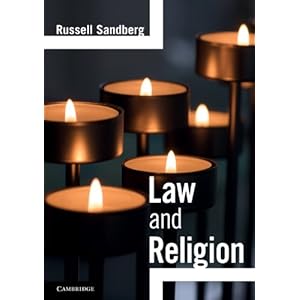
The LARSN conference will also include the annual meeting of LARSN and the book launch for Russell Sandberg’s ‘Law and Religion’, which will be published by Cambridge University Press this Spring.

LARSN will be followed on Wednesday 18th May by a one day Symposium which will disseminate the findings of Cardiff’s ‘Social Cohesion and Civil Law: Marriage, Divorce and Religious Courts’ project, a study of religious courts and tribunals, which has been funded by the AHRC/ESRC Religion and Society Programme.

The full programme and booking form for both of these events will be available from the website of Cardiff’s Centre for Law and Religion from Friday 25th March 2011. http://www.law.cf.ac.uk/clr/

Lunch and refreshments for the LARSN conference will be provided by the Centre for Law and Religion. Unfortunately, the Centre is unable to cover transport and accommodation costs for this event.

LARSN was established in May 2008 as a national initiative led by the Centre for Law and Religion at Cardiff University. It seeks to bring together those who are interested in all areas of law and religion: national and international law affecting religion and religious law.

If you have any queries, please do not hesitate to contact Russell Sandberg (SandbergR@cf.ac.uk)