29 August 2013

SPD: On the Road Again

On my last trip of the summer, teaching in beautiful Urbino (doing what I do).

I wish you were here.

Maybe next year ...

23 August 2013

JOURNAL: (2013) 6:1 Journal of Civil Law Studies


(2013) 6:1 Journal of Civil Law Studies is now published. The issue in its entirety and each individual article are available at http://digitalcommons.law.lsu.edu/jcls/. For an overview, see the LSU Law Wordwide Blog.

BOOK: Descheemaeker and Scott on Iniuria and the Common Law

Hart Publishing has published the following:

Edited by Eric Descheemaeker and Helen Scott

The delict of iniuria is among the most sophisticated products of the Roman legal tradition. The original focus of the delict was assault, although iniuria-literally a wrong or unlawful act-indicated a very wide potential scope. Yet it quickly grew to include sexual harassment and defamation, and by the first century CE it had been re-oriented around the concept of contumelia so as to incorporate a range of new wrongs, including insult and invasion of privacy. In truth, it now comprised all attacks on personality.

It is the Roman delict of iniuria which forms the foundation of both the South African and-more controversially-Scots laws of injuries to personality. On the other hand, iniuria is a concept formally alien to English law. But as its title suggests, this book of essays is representative of a species of legal scholarship best described as 'oxymoronic comparative law', employing a concept peculiar to one legal tradition in order to interrogate another where, apparently, it does not belong. Addressing a series of doctrinal puzzles within the law of assault, defamation and breach of privacy, it considers in what respects the Roman delict of iniuria overlaps with its modern counterparts in England, Scotland and South Africa; the differences and similarities between the analytical frameworks employed in the ancient and modern law; and the degree to which the Roman proto-delict points the way to future developments in each of these three legal systems.

Eric Descheemaeker is a Lecturer in European Private Law at the University of Edinburgh.

Helen Scott is an Associate Professor in the Department of Private Law at the University of Cape Town.

22 August 2013

BLOG: Larry Catá Backer on Elements of Law


Readers might be interested in a class that Larry Catá Backer has been discussing on his Law at the End of the Day Blog.

So far, he's written about the class--Elements of Law-- in two posts:


Among other things, the class brought to mind Roderick A Mcdonald and Jason MacLean, 'No Toilets in Park' (2005) 50 McGill Law Journal/Revue de droit de McGill 721.

Have a look. 
- SPD

21 August 2013

JOURNAL: German Law Journal

The new issue of the German Law Journal, Review of Developments in German, European and International Jurisprudence is now available at www.germanlawjournal.com.


The new issue is an international and comparative Symposium on Constitutional Reasoning, which brings together an impressive and inspiring international group of scholars in constitutional law, comparative law, legal theory and legal philosophy. The Symposium, as highlighted by the author of the introduction, the President of the Federal Constitutional Court of Germany, Professor Andreas Vosskuhle, is both timely and on the cutting edge of comparative constitutionalism, as it illustrates the relevance of contextualized and historically informed comparative jurisprudence. Such scholarship navigates the boundaries between adjudication and comparative constitutional theory and further informs the fast growing and increasingly global practice and discourse on judicial dialogue.

CONFERENCE: 2013 American Society of Comparative Law Annual Meeting

UALR William H. Bowen School of Law to Host 2013 Conference

The  William H. Bowen School of Law will host the 2013 American Society of Comparative Law annual meeting.

The event will be held Oct. 10-12, 2013, in Little Rock.

The American Society of Comparative Law (ASCL) is the leading organization in the United States promoting the comparative study of law. Founded in 1951, the Society publishes The American Journal of Comparative Law, the outstanding American publication of scholarship on comparative law.


Registration information

BOOK: Possami, Richardson, and Turner on Legal Pluralism and Shari’a Law

Prakash Shah mentioned the following new book on Pluri-Legal:

Adam Possami, James T Richardson, and Bryan Turner (eds),  
Legal Pluralism and Shari’a Law

Legal pluralism has often been associated with post-colonial legal developments especially where common law survived alongside tribal and customary laws. Focusing on Shari‘a, this book examines the legal policies and experiences of various societies with different traditions of citizenship, secularism and common law. Where large diasporic communities of migrants develop, there will be some demand for the institutionalization of Shari‘a at least in the resolution of domestic disputes. This book tests the limits of multiculturalism by exploring the issue that any recognition of cultural differences might imply similar recognition of legal differences. It also explores the debate about post-secular societies specifically to the presentation and justification of beliefs and institutions by both religious and secular citizens.

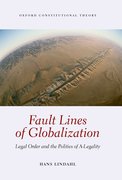
BOOK: Lindahl on Fault Lines of Globalization:

Fault Lines of Globalization Legal Order and the Politics of A-LegalityOxford University Press will soon publish Hans Lindahl, Fault lines of globalization: legal order and the politics of a-legality:


The question whether and how boundaries might individuate and constitute a legal order has yet to be discussed in a systematic and comprehensive manner by legal and political theory. This book seeks to address this important omission, providing an original contribution to the debate about law in a global setting. It opposes the widely endorsed assumption that we are now moving towards law without boundaries, and argues that every imaginable legal order, global or otherwise, is bounded in space, time, membership, and content.The book is built up around three main insights. Firstly, that legal orders can best be understood as a form of joint action in which authorities mediate and uphold who ought to do what, where, and when with a view to realising the normative point of acting together. Secondly, that behaviour can call into question the boundaries that determine who ought to do what, where and when: a-legality. Thirdly, that this a-legality reveals boundaries as marking a limit and, to a lesser or greater extent, a fault line of the respective legal order.

CONFERENCE: Contrasting Minority and Indigenous Rights in Practice

UK Network on Minority Groups and Human Rights
Conference: Contrasting Minority and Indigenous Rights in Practice
28 October 2013: Call for Papers and Panels

The UK Network on Minority Groups and Human Rights was established in May 2009 to provide a specialist interdisciplinary forum for scholars working in the area of minority and indigenous rights to meet and discuss new developments, focusing in particular on the development of links between early career and more established researchers working in this area. More information on the Network can be found here: http://www.sas.ac.uk/hrc/networks. The third Network conference will be held at Senate House, School of Advanced Study, University of London on 28 October 2013. Funding for the workshop has been secured from the Human Rights Consortium at the School of Advanced Study.

The main theme of this conference will be to examine the contrasts between the minority rights and indigenous rights legal framework, discourse and practice by juxtaposing the two regimes on panels focused on a specific theme. For example, a panel may include papers on the experience of extractive industries by both minorities and indigenous peoples to highlight how the different legal frameworks translate to practice, how communities are working together or in conflict, and how states have responded differently to these distinct groups. We aim to raise some critical questions about the evolution of the legal frameworks and tensions in practice that have resulted from distinct protection tools.

In addition, the conference will include panels and papers on other themes pertaining to minority rights and indigenous peoples’ rights. Thus, we are making both an open call for papers on any theme related to the Network’s work and a call for papers and panels that address the specific theme of this year’s conference.

BOOKS: Legal Argumentation and Jewish Law

Legal Argumentation Theory: Cross-Disciplinary PerspectivesThe following two books have been brought to my attention.

Christian Dahlman and Eveline Feteris (eds), Legal argumentation theory: cross-disciplinary perspectives


This book offers its readers an overview of recent developments in the theory of legal argumentation written by representatives from various disciplines, including argumentation theory, philosophy of law, logic and artificial intelligence. It presents an overview of contributions representative of different academic and legal cultures, and different continents and countries. The book contains contributions on strategic maneuvering, argumentum ad absurdum, argumentum ad hominem, consequentialist argumentation, weighing and balancing, the relation between legal argumentation and truth, the distinction between the context of discovery and context of justification, and the role of constitutive and regulative rules in legal argumentation. It is based on a selection of papers that were presented in the special workshop on Legal Argumentation organized at the 25th IVR World Congress for Philosophy of Law and Social Philosophy held 15-20 August 2011 in Frankfurt, Germany.

Yona Ghertman, La loi juive dans tous ses états: de l'actualité du droit rabbinique à notre époque

Plus qu'une religion, le Judaïsme apparaît comme une Loi. L'étude du Talmud et de la Halakha (Loi juive) représente un va-et-vient entre l'étude de l'Histoire du Droit et celle du Droit contemporain.