Selections
of articles have been specially
chosen by the
Editors to show the quality and
diversity of the ICLQ.
Each selection
can be accessed online
without charge by following this link.
28 February 2012
NOTICE: International & Comparative Law Quarterly
23 February 2012
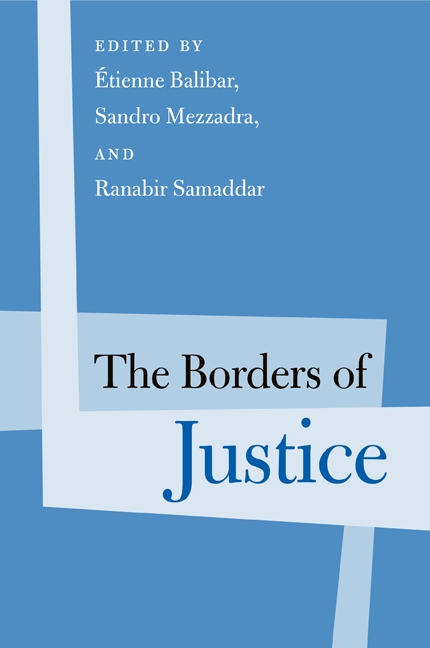
Temple University Press has recently released Etienne Balibar, Sandro Mezzadra, and Ranabir Samaddar, The Borders of Justice (2012):
International in scope and featuring a diverse group of contributors, The Borders of Justice investigates the complexities of transitional justice that emerge from its “social embeddedness.” This original and provocative collection of essays, which stem from a collective research program on social justice undertaken by the Calcutta Research Group, confronts the concept and practices of justice. The editors and contributors question the relationships between geography, methodology, and justice--how and why justice is meted out differently in different places. Expanding on Michael Walzer’s idea of the “spheres of justice,” the contributors argue that justice is burdened with our notions of social realities and expectations, in addition to the influence of money, law, and government.
To order a copy please contact Marston on +44(0)1235 465500 or email direct.orders@marston.co.uk or visit http://bit.ly/w0FII6
"The Borders of Justice interrogates the concept and practices of justice in original and provocative ways, combining the geographical diversity of the authors with a variety of disciplinary and methodological approaches. The essays reveal how justice appears differently in different places and from different perspectives. This is an important contribution to contemporary debates on justice."
—Michael Hardt, Professor of Literature at Duke University, and co-author (with Antonio Negri) of Empire, Multitude: War and Democracy in the Age of Empire, and Commonwealth
To order a copy please contact Marston on +44(0)1235 465500 or email direct.orders@marston.co.uk or visit http://bit.ly/w0FII6
"The Borders of Justice interrogates the concept and practices of justice in original and provocative ways, combining the geographical diversity of the authors with a variety of disciplinary and methodological approaches. The essays reveal how justice appears differently in different places and from different perspectives. This is an important contribution to contemporary debates on justice."
—Michael Hardt, Professor of Literature at Duke University, and co-author (with Antonio Negri) of Empire, Multitude: War and Democracy in the Age of Empire, and Commonwealth
12 February 2012
NOTICE: WORKSHOP AND CONFERENCE ON LEGAL PLURALISM IN NATURAL RESOURCE MANAGEMENT
The following may be of interest. Apologies for the late notice:
Commission on Legal Pluralism
A group of Indian scholars is organizing a seminar on legal pluralism and natural resource management which will take place on March 30 and 31st, 2012, in Coimbatore, South India. They would like to have some participation also from the SE Asia network of the Commission, and there is actually some funding available to bring 1-2 members to India for this purpose. Further information can be found below. Interested persons can contact Dr Amalendu via ailp_conference@cb.amrita.edu.
Venue: Amrita University, Ettimadai, Coimbatore, India
Date of workshop: 30th March 2012
Date of Conference: 31st March 2012
Theme
Commission on Legal Pluralism
30th and 31st March 2012
Conference Organised at Amrita School of Business
By Asian Initiative on Legal Pluralism
and supported by Commission on Legal Pluralism
Venue: Amrita University, Ettimadai, Coimbatore, India
Date of workshop: 30th March 2012
Date of Conference: 31st March 2012
Theme
NOTICE: FAURE AND SMITS, DOES LAW MATTER?
Intersentia has recently published Michael Faure and Jan Smits (eds), Does law matter? on law and economic growth (2011), the 100th volume of the Ius Commune Europaeum Series.
For many years now, there has been a strong economic scholarship pointing to the importance of institutions in general - and, more particularly, legal rules and the rule of law - for economic development. The importance of law for economic growth has also been empirically tested in many well-known and often cited studies. These studies seem to indicate not only that law is relevant in the development of countries and their economic growth in particular, but more specifically, that particular legal systems do better than others. The tenant of this scholarship (especially initiated by Andrej Schleifer and others) is that the common law would be a more efficient system in promoting economic growth than the civil law. However, many scholars doubt the empirical claim of this and criticize these findings, both on methodological grounds as well as on grounds of a misconception of differences between the civil and the common law. The interest in legal origins for the efficiency of the legal system also focuses on particular legal regimes, such as accident law, environmental law, or corporate law. Increasingly, the question is also asked whether legal institutions and the rule of law are also important in the process whereby poor nations develop their economy. For example, Cooter, Schafer, and Ulen have attempted to examine why particular developing countries do relatively better than others and, roughly speaking, also attribute (part of the) success of some developing countries to legal institutions. However, others (more particularly Ulen) point at the fact that legal rules may play some role, but perhaps only a modest role in economic development. A powerful example which is quoted in that respect is the one of China which, at least at first blush, does not seem to rely strongly on legal institutions (at least in the traditional sense) and nevertheless has experienced a spectacular economic growth. The particular case of China hence remains somewhat puzzling in this debate. So far, these various streams of literature paying attention to the question to what extent legal origins matter for economic growth have not been strongly integrated and have, to a large extent, been developed in separate social sciences (institutional economics, development economics, and comparative law). This multi-disciplinary book brings these approaches together in an integrated and structural manner. (Series: Ius Commune Europaeum - Vol. 100
The introduction is available on SSRN.
08 February 2012
NOTICE: Seminar on Indigenous Peoples’ Languages and Cultures
Dear colleague,
The theme of the Expert Seminar will be “Indigenous Peoples’ Languages and Cultures”.
In resolution 18/8 of September 2011 the United Nations Human Rights Council requested the Expert Mechanism on the Rights of Indigenous Peoples to prepare a study on the role of languages and culture in the promotion and protection of the rights and identity of indigenous peoples. It is envisaged that the Expert Seminar will help the development of the Study that the Expert Mechanism will submit to the UN Human Rights Council.
CALL FOR PROPOSALS: &LAW
Call for Proposals
Announcing a New Series: &LAW
DESCRIPTION: The series, sponsored by The University of Akron School of Law and published by The University of Akron Press, will be comprised of one or two publications annually. The series will be available in traditional print format and e-book formats.
SUBMISSION PROCEDURE: Book proposals should be sent to:
Professor of Law
The University of Akron School of Law
Akron, OH 44325-2901
(330) 972-6617
thomast@uakron.edu
CALL FOR PAPERS: Australia New Zealand Law & History Society
The following Call for Papers was lifted straight from the Legal History Blog:
CFP: Australia New Zealand Law & History Society
Posted by Dan Ernst
[Here's a call for papers for what appears
to be a particularly well-crafted annual meeting of Antipodean legal historians,
to be held at the University of Technology,
Sydney (UTS). The organizers tell me that they are keen to have "many of
our North American colleagues" attend. Here
is the link to the conference website; here
a link to another conference at UTS, on the "historical connections" between the
legal profession and defense forces; here
a link to yet another, on feminism and the law that will include "revisiting the
past."]
The 31st Annual Conference of the Australia New Zealand Law and History Society will be held at the University of Technology, Sydney (UTS), 10-12 December 2012. UTS is the most centrally located law school in Sydney, situated next to Central Station, on the edge of China Town, three minutes by monorail from Sydney’s central shopping district and a short trip to the harbour by direct train or bus.
The conference theme is “Receiving Laws/Giving Laws”. It is orientated towards the movement, transmission and transformation of laws and their histories – across Empire, through time, in and between genres and disciplines. The receiving and giving of laws could be addressed in a broad range of ways. How do laws and histories translocate? By what means (doctrinal, processual, cultural) are laws transmitted and received in new places? What transformations happen as a result of this movement? Whose histories, cultures and laws appear and disappear through these transformations? What kinds of interventions can bring about ways of transforming, perceiving and transmitting the law and its histories/cultures?
07 February 2012
NOTICE: New Issue of LEGISPRUDENCE
The latest issue of Legisprudence: International Journal for the Study of Legislation has been published.
The journal includes an interesting article by Juris Diversitas member Jaakko Husa on 'European Polynomia and Pluralist Methodology'. Its abstract reads:
Globalisation and Europeanisation do not only produce coherence and uniformity but are flanked by differentiation and fragmentation, producing diverse and polycentric outcomes. This article puts forth reflections on European legal pluralism and a proposition for pluralist methodology. The author claims that in today's Europe there is legal pluralism, which means that there are many overlapping normative orders in Europe. It is claimed that Europe is fundamentally pluralistic. Hence there are overlapping non-coherent hierarchies and competing claims for normative power. This is conceptualised as polynomia. The article seeks to demonstrate that legal pluralism in the strong sense has penetrated into European legal doctrine. This state of affairs is claimed to result in a situation in which pluralism is not something that would concern legal anthropologists, legal historians or sociologist of law only. According to this article, doctrinal methods forged in the moulds of legal centralism and monism are outdated and respond poorly to the present day European legal pluralism.
Nicolle Zeegers - How to Theorise Collective Decision Making Concerning Legal Rules? The Need to Acknowledge the Rhetorical as Well as the Rational Variables
The journal includes an interesting article by Juris Diversitas member Jaakko Husa on 'European Polynomia and Pluralist Methodology'. Its abstract reads:
The journal includes:
Jaakko Husa - The Method Is Dead, Long Live the Methods! European Polynomia and Pluralist Methodology
Mirko Pečarič - A Dynamic Reflection on the Factual State of Affairs through an Experimental Norm
Demetrius Klitou - Privacy by Design and Privacy-Invading Technologies: Safeguarding Privacy, Liberty and Security in the 21st Century
Nicolle Zeegers - How to Theorise Collective Decision Making Concerning Legal Rules? The Need to Acknowledge the Rhetorical as Well as the Rational Variables
06 February 2012
CALL FOR PAPERS: Revelation and Interpretation Conference
Conference and Call for Papers: Revelation and Interpretation
Legal Interpretation of Religious Texts
The International Conference will be held at NYU School of Law on September 11-12, 2012. The conference will focus on the legal interpretation of religious texts, in order to explore the characters and methodologies of such interpretation whether within a particular tradition or on a a comparative basis between different traditions.
NOTICE: LAW IN THE FRENCH ATLANTIC Symposium
2012-13 Symposium on Comparative Early Modern Legal History
Friday, October 5, 2012
9:00 a.m.-5:00 p.m.
Law and the French Atlantic
Organized by Allan Greer, McGill University, and Richard J. Ross, University of Illinois at Urbana-Champaign.
The French Atlantic has not yet received the sustained attention given to the
British and Spanish Atlantic, particularly where the topic of law is concerned.
This conference will explore the legal dimension (broadly conceived) of the
French Atlantic empire in the early modern period. The variegated and rapidly
evolving juridical order of ancien régime France was deeply implicated in the
expansion of overseas commerce, the founding of colonies, and the creation of
imperial administrations.
Participants may explore topics such as: legal discourse and imperial ideologies; the establishment of colonial jurisdictions in Canada, Louisiana, and the French West Indies; the regulation of slavery; indigenous peoples and the law; the emergence of colonial land tenures; and the legal framework for trade and business enterprise. The organizers wish particularly to encourage comparative approaches that consider more than one French colony and that examine contrasts and convergences with the British, Spanish and Portuguese empires. In according due attention to the distinctive features of French law and the French New World empire, we hope to enrich understandings of Atlantic history generally.
Subscribe to:
Posts (Atom)