24 November 2010

NOTICE: (2010) 3 Journal of Civil Law Studies


The Center of Civil Law Studies announces the publication of Volume 3 of the Journal of Civil Law Studies (JCLS). Volumes 1, 2, and 3 of the JCLS are freely accessible online, at www.law.lsu.edu/jcls.


Volume 3 of the JCLS contains the papers of the Saúl Litvinoff Civil Law Workshop Series. The general theme was Civil Law and Common Law: Cross Influences, Contamination, and Permeability.

  • Foreword, Olivier Moréteau & Ronald Scalise Jr.
  • An Introduction to Contamination, Olivier Moréteau
  • Don Saúl Litvinoff (1925-2010), Agustín Parise & Julio Romañach Jr.
  • Foundations for a Revival of the Case Method in Civil Law Education, Fernando M. Toller
  • The Vienna Sales Convention (CISG) between Civil and Common law–Best of all Worlds?, Ulrich Magnus
  • Legal Theory and the Variety of Legal Cultures, Sheldon Leader
  • The Reform of Legal Education in China and Japan: Shifting from the Continental to the American Model, Xiangshun Ding
  • Press Freedom in Indonesia: A Case of Draconian Laws, Statutory Misinterpretation, but still one of the Freest in Southeast Asia, Nono Anwar Makarim
  • Common Law, Civil Law, and the Challenge from Federalism, Santiago Legarr
  • The Principle of Proportionality: The Challenges of Human Rights, Juan Cianciardo
  • Academic Legal Writings by Saúl Litvinoff

23 November 2010

NOTICE: Palmer on the Louisiana Supreme Court


Professor Palmer has just informed me of his 'corrected' study of the Louisiana Supreme Court. Both Louisianians and non-Louisianians will find it interesting. - SPD

Dear Colleagues, I am pleased to inform you that my corrected study has just been published in Global Jurist (Berkeley Press). Please see my covering “note” to the reader below, and you may access the article without charge through the links indicated.

Best wishes, Vernon

New Corrected Study on the Louisiana Supreme Court
and Campaign Contributions
Published in Global Jurist - November, 2010.
Read the Article in Global Jurist

A Note from the Author - Vernon Palmer:

It is the duty of a scholar, I believe, to admit and correct his errors. The important thing is to set the record straight and to advance the truth.

In that spirit I am presenting my latest publication, The Recusal of American Judges in the Post-Caperton Era: An Empirical Assessment of the Risk of Actual Bias in Decisions Involving Campaign Contributors. This new article expands upon and carefully corrects my previous study published in the Tulane Law Review (2008) concerning the influence of campaign contributions on the Louisiana Supreme Court. The previous study was sharply criticized by the Justices who pointed out a number of errors in the data and called for corrections and an apology.

After two years of painstaking research and rechecking, here are my republished results.

The striking thing is that the overall conclusions of the first study remain basically unchanged. Furthermore, the calculations have been independently confirmed and replicated by an outside research institute. Thus the present study rests not only on a strong foundation but it reaffirms the general finding that the Court’s refusal to recuse itself in campaign contributor situations is a threat to the court’s own impartiality and reveals a risk of actual bias.

The findings are summarized on pp. 6-9 of the text. Among other things they show the Court, as a whole, votes for its contributors on average about 65% of the time (in nearly two out of three cases); individually, certain Justices greatly exceed 65%. One Justice voted for his contributors’ side of the case 100% of the time. That percentage reflects a serious risk of actual bias. There is also evidence of similar risk when the Court faced contributors on both sides of the case. The voting of certain Justices was anomalous. They sharply favored the larger of the two contributors, regardless of the side he was on, and though it contrasted with their general voting tendency when no money was involved.

The expanded investigation also brings to light, for the first time, detailed data about the occult and little-known practice of accepting campaign contributions from litigants in cases under deliberation. The data reveal that a number of Justices vote for the position of their sub judice contributors 100% of the time. This has an appearance of impropriety and also reflects a significant risk of actual bias.

© 2010 - Vernon Palmer

20 November 2010

NOTICE: Feliu, Kim-Prieto, and Miguel on the Spanish Roots of Louisiana Civil Law

Vicenç Feliú, Dennis Kim-Prieto, and Teresa M Miguel have written "A Closer Look: A Symposium Among Legal Historians and Law Librarians to Uncover the Spanish Roots of the Louisiana Civil Law":

The debate regarding whether the origin of Louisiana civil law is based in the Spanish or in the French legal tradition has been ongoing since that state’s incorporation into the United States as a result of the Louisiana Purchase. Distinguished legal scholars have argued in favor of one tradition being dominant over the other, and each has been staunch in support of that view. This article proposes and demonstrates that the Spanish, not French, civil law had an enormous influence on the creation and evolution of Louisiana civil law, and that this legacy resonates today.

The article begins with a brief historical account of the formation of Louisiana from territory to statehood. It then closely examines the contributions of Louis Casimir Elisabeth Moreau Lislet, the architect of the Digest of 1808 and the Code of 1825. Original Spanish documents and resources that were the foundation of the Digest of 1808 are analyzed and used to demonstrate how these Spanish civil law sources had a profound impact on Moreau Lislet and on the creation of Louisiana civil law. Finally the continuing evolution of Louisiana civil law and the now-famous Batiza-Pascal debate on the origins of the Louisiana civil law are carefully examined.

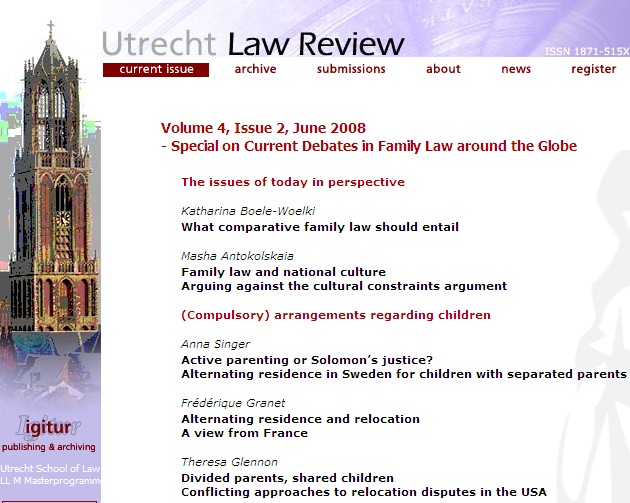
NOTICE: Utrect Law Review

Note that the (2010) 6:3 Utrecht Law Review is now available.

It's a special issue on Euroscepticism and Multiculturalism. It contains the following:

Frank van Schendel, Irene Aronstein
Introduction – Euroscepticism and multiculturalism

Veit Bader
Constitutionalizing secularism, alternative secularisms or liberal-democratic constitutionalism? A critical reading of some Turkish, ECtHR and Indian Supreme Court cases on ‘secularism’

Leonard F.M. Besselink
National and constitutional identity before and after Lisbon

Ruth Sefton-Green
Multiculturalism, Europhilia and harmonization: harmony or disharmony?

Jan M. Smits
Beyond Euroscepticism: on the choice of legal regimes as empowerment of citizens

Esin Örücü
Diverse cultures and official laws: multiculturalism and Euroscepticism?

Irene Aronstein
‘The Union shall respect cultural diversity and national identities’ Lisbon’s concessions to Euroscepticism – true promises or a booby-trap?

10 November 2010

CALL FOR PAPERS: Northern Ireland Legal Quarterly Special Issue

The following Call for Papers might be of interest:

CALL FOR PAPERS
Northern Ireland Legal Quarterly
Special Issue
Bench and Bar: The (Dis)appearance of Britain

We are compiling a Special Issue for the Northern Ireland Legal Quarterly (NILQ) on the topic of ‘Bench and Bar: The (Dis)appearance of Britain’. We wish to invite scholars with an interest in this broad theme to submit abstracts of around 250 words by Friday 31 December 2010. We will make a provisional selection by the end of January 2011 and then ask contributors to provide a full draft of their text by Tuesday 31 May 2011. These will then be refereed blind in the usual way. Final articles accepted for publication should be with the NILQ by November 2011 for publication in the first volume of 2012.


As the British Empire extended its reach during the eighteenth and nineteenth centuries, Western (specifically British) concepts of law and justice were exported around the world. As the empire retracted in the twentieth century, a residual legal order was left in its wake: the common law. In many colonies and British territories, the early twentieth century was a time of uncertainty. As the roles of the imperial parliament and the judicial committee of the Privy Council changed, national legal systems began to emerge.

This Special Issue of the Northern Ireland Legal Quarterly seeks to address some of the issues which have arisen as a consequence of the (dis)appearance of British Imperialism.

Suggested topics include (but are not limited to):
  • The role of national courts and legislatures in shaping ‘new’ legal orders
  • How tension between old and new orders was resolved
  • How the judiciary and legal community responded to the abolition of Privy Council appeals
  • The role of law in the formation of new states
  • How former colonies and dominions have diverged in their interpretation and development of common law principles
  • The role of lawyers and legal professions in the transition from imperialism to independence
  • Whether British systems of law and justice continue to exert influence over the legal systems of its former territories; and whether lawmakers in former colonies have looked and continue to look towards Britain for guidance
  • The Bench and Bar in the UK and the colonies, for example:
    • How was the English model exported?
    • The extent to which the English model is still used?
    • Whether ex-colonies made changes to their legal professions in the aftermath of independence?
  • The influence of individuals who migrated from the English bar to the colonial bars?
Please send abstracts via email attachment to:

Dr Karen Brennan, Queen’s University of Belfast, School of Law, k.brennan@qub.ac.uk
Dr Niamh Howlin, Queen’s University of Belfast, School of Law, n.howlin@qub.ac.uk
Dr Sara Ramshaw, Queen’s University of Belfast, School of Law, s.ramshaw@qub.ac.uk

07 November 2010

Italian Association of Comparative Law bi-annual conference, Venice, 9-11 June 2011

The Italian Association of Comparative Law launched a call for papers in relation to its bi-annual conference, which in 2011 will be be held in Venice, on 9-11 June. The call for papers indicates 31 January 2011 as the deadline for submisison of an abstract.
The general, or main, subject of the conference seems to be related to law and governance issues. Several interesting topics have been listed, including one related to legal hybridity.
Details on http://aidcblog.blogspot.com/2010/11/venice-2011-aidc-xxi-conference.html

01 November 2010

NOTICE: Ashgate Library of Essays in Contemporary Legal Theory

Ashgate has announced an excellent new three-volume Library of Essays in Contemporary Legal Theory:

Series Editors: William Twining, University College London, UK, Wil Waluchow, McMaster University, Canada, Michael Giudice, York University, Canada and Maksymilian Del Mar, Edinburgh University, UK

Library of Essays in Contemporary Legal Theory The discipline of legal theory has flourished over the last thirty years, as shown by the proliferation of methodological debates and controversies. These debates are not only relevant to how legal theory understands its own enterprise: its problems, aims and issues of scope. They are also relevant to many other aspects of the practice of legal theory, for example its role vis-à-vis the practice of law and the practice of other related activities, such as legal scholarship and legal education. As the ambitions of legal theory grow, so do questions concerning its relations with other disciplines, such as comparative law, but also, much more broadly, the social sciences.

This three volume series on contemporary legal theory brings together a selection of previously published articles from leading legal theorists which are key papers in the discussion of the above controversies and challenges. Each volume opens with a substantial introduction to the papers and their context and ends with a selective bibliography for further reading.

NOTICE: Colonies and Postcolonies of Law Conference (18 March 2011)

I just received information on the following:

COLONIES AND POSTCOLONIES OF LAW
History Department, Princeton University Friday, March 18th 2011

The conference addresses the centrality of law in the construction of colonial rule. We aim to examine how colonial law emerged as colonialists interacted with diverse populations in the colonies. The study of the relationship between law and colonialism has taken two broad trajectories.
 
On one hand, scholars have highlighted how law provided the instruments for the creation of the colonial state, allowing it to exercise a vast amount of power in restructuring the colony. Conversely, law opened up avenues of resistance for colonized populations. This conference aims to go beyond this dichotomy by focusing on law as a site of constant negotiation which produced new forms of bureaucracy and documentation practices. As colonial legal systems cast long shadows and formed the bedrock of the national legal systems today, this conference will also examine how these colonial legal regimes influence postcolonial nations. The last few years has seen a growth of interest in colonial legal history to which this conference hopes to contribute by bringing junior scholars together in conversation.

NYU Professor of History Lauren Benton will deliver a keynote address at the conference.

Sub themes

Defining Legality: Criminals, Outlaws and Rebels - New categories of legality emerged during the colonial period such that criminals and rebels became interchangeable notions. What makes a ‘rebel’ and a ‘criminal’? What counts as evidence of a crime? How were penal regimes created? How did colonial regimes contribute to the construction of the international laws of war and human rights?

Competing Legitimacies: Religious Law and Colonial Authority - The colonial state grappled with existing legal systems in the colony. Some systems were delegitimized while others were bolstered under the purview of colonial rule. By privileging certain forms of legitimacy, colonial states challenged traditional norms and institutions such as customary rights and religious laws. Why were certain legal systems granted legitimacy under the colonial rule? How did certain religious texts and figures emerge as more authoritative than others? How did the process of translation change understandings of key religious concepts? What forms of tensions were created between traditional authorities and the emerging modern legal profession in the colony?

Private Lives and Public Law - The modern colonial state crafted new boundaries between the public and private. For example, colonial projects of social reform transformed marital and kinship relations. How did the colonial legal regime come to delineate the private and the public sphere? How did colonized populations engage with this process of delineation? How did the changing legal order affect colonial subjects, in particular women, who often emerged as the sites for legal reform? Did postcolonial nations adopt colonial legal conceptions of the private and public spheres?

Constructing Borders - Colonial law demanded certainty of boundaries and jurisdiction, yet it operated within a plural legal order and had limited capacity to police frontiers. How were legal borders fixed? How did colonial populations choose between competing forums granted by neighboring jurisdictions? How did the emergence of the postcolonial nations complicate colonial mapping and jurisdictional jostling?

Law and Capital - The centrality of trade and capital to the colonial project is increasingly overshadowed by cultural and social histories. Law, in the form of land revenue, forest laws and mercantile regulations, was in fact, central to the economic project of the colonial state. Can law be used to bring economic histories in conversation with the social and cultural? What economic practices came to be legitimized with the colonial reordering of the economy? How did colonial law engage with older kinship based mercantile networks such as those of the Arabs, Chinese, Parsis and Marwaris?

Paper proposals should include a title, a 350-word abstract, institutional affiliation and contact information. Please submit proposals to coloniesoflaw@gmail.com by December 15th 2010.

Organizers: Nurfadzilah Yahaya and Rohit De, History Department, Princeton University

NOTICE: Annual Review of Law and Social Science

The latest (2010) 6 Annual Review of Law and Social Science is now available online. The list of articles is extensive, but includes the following:
  • Annual ReviewsRichard L. Abel, Law and Society: Project and Practice
  • Lee Epstein and Tonja Jacobi, The Strategic Analysis of Judicial Decisions
  • Alejandro de la Fuente and Ariela Gross, Comparative Studies of Law, Slavery, and Race in the Americas
  • Mark C. Suchman and Elizabeth Mertz, Toward a New Legal Empiricism: Empirical Legal Studies and New Legal Realism
  • Shari Seidman Diamond and Pam Mueller, Empirical Legal Scholarship in Law Reviews
  • Lauren B. Edelman, Gwendolyn Leachman, and Doug McAdam, On Law, Organizations, and Social Movements

20 October 2010

NOTICE: Pimentel on legal pluralism in post-colonial Africa

David Pimentel's Legal pluralism in post-colonial Africa: linking statutory and customary adjudication in Mozambique is now available on SSRN. The abstract reads:

File:Flag of Mozambique.svgLegal pluralism is a contemporary reality and a challenge in most post-colonial African states, as they grapple with how to preserve the cultural heritage reflected in their customary law and institutions, while attempting to function as modern constitutional regimes. Few of them have found structural solutions for linkages between and mutual co-existence of multiple legal regimes within the same state.

The policy that will drive the establishment of proper linkages must be approached with an eye to what the purpose of preserving a legally pluralistic regime, distinguishing the motivations of many - colonists in the past, and political opportunists today - who have exploited pluralistic systems for their own self-interest. It is also necessary to recognize and preserve the virtues inherent in customary systems - systems historically undervalued as “primitive,” and still under attack by those who see them as threats to the protection of human rights.

There are no easy answers for how to correlate and link pluralistic adjudication in post-colonial African states, and Mozambique may present a particularly troublesome case. Although the precise mechanisms cannot be articulated with specificity, perhaps, the core underlying principles can. Those principles should respect traditional systems and values, affording them dignity as independent systems. To make them subservient to the state institutions, allowed to exist as long as they serve the state institutions on the state’s terms, would be nothing more than a repackaging and relabeling of tried-and-failed colonial approaches.

Instead, the pluralistic regime should operate on the principle of “maximizing” the role and impact of indigenous law, and giving equal dignity to the institutions that apply such law. This will require state courts to defer to community-based adjudication, even declining to exercise jurisdiction when the case can be appropriately resolved in the latter forum. It will grant concurrent jurisdiction wherever possible, supplementing it with consent jurisdiction for those who could not otherwise be subject to the authority of the traditional forum.

The most troubling aspects of traditional law, the oft-cited human rights violations, cannot be ignored. A mechanism can and must be developed for guarding against those, doing as little violence as possible to the autonomy and dignity of traditional fora. A system of collateral review - giving statutory courts limited jurisdiction to review a traditional forum’s decision for compliance with constitutional human rights standards - can serve that function. It is calculated to tamper with traditional dispute resolution systems as little as possible, and to respect the community forum as much as possible. Most importantly, it allows customary law to respond in its own way to the human rights requirements, not threatening customary law with restrictions, but strengthening customary law by fostering its legitimacy and relevance. Most importantly, it will allow the customary law, and its application, to remain solely the province of traditional authorities, where it can continue to function as a vital and highly adaptive foundation in rural society.

Operational solutions - for Mozambique as well as other pluralistic societies that face similar challenges - will require ongoing attention, but the central values of legal pluralism can be maintained as long as the implementation does not stray from these core principles: maximization of indigenous law, and equal dignity for the traditional forum.